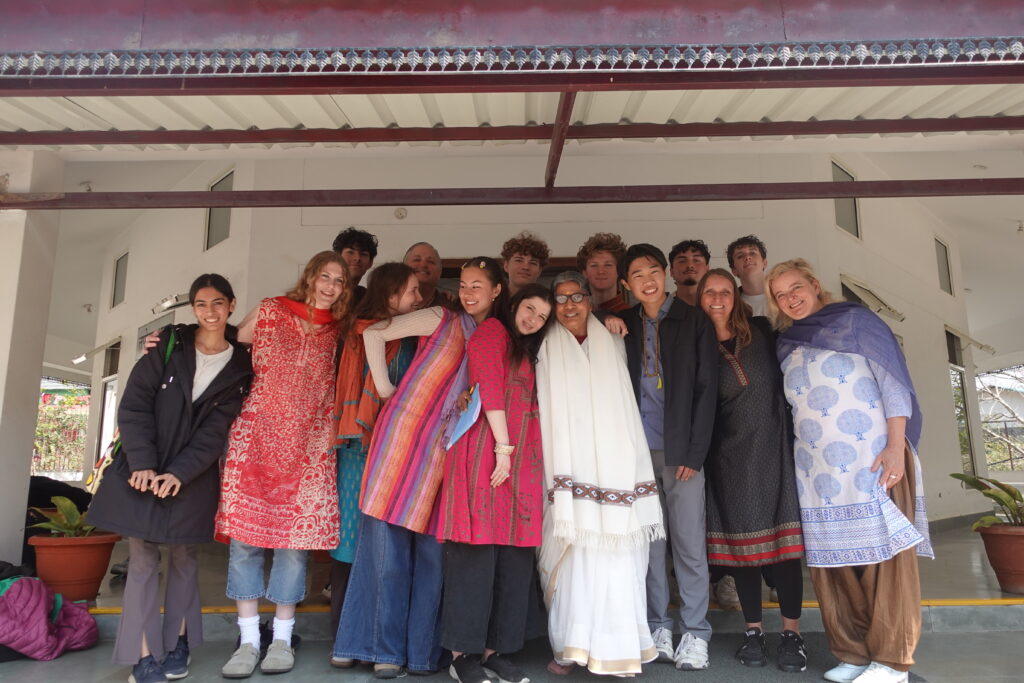
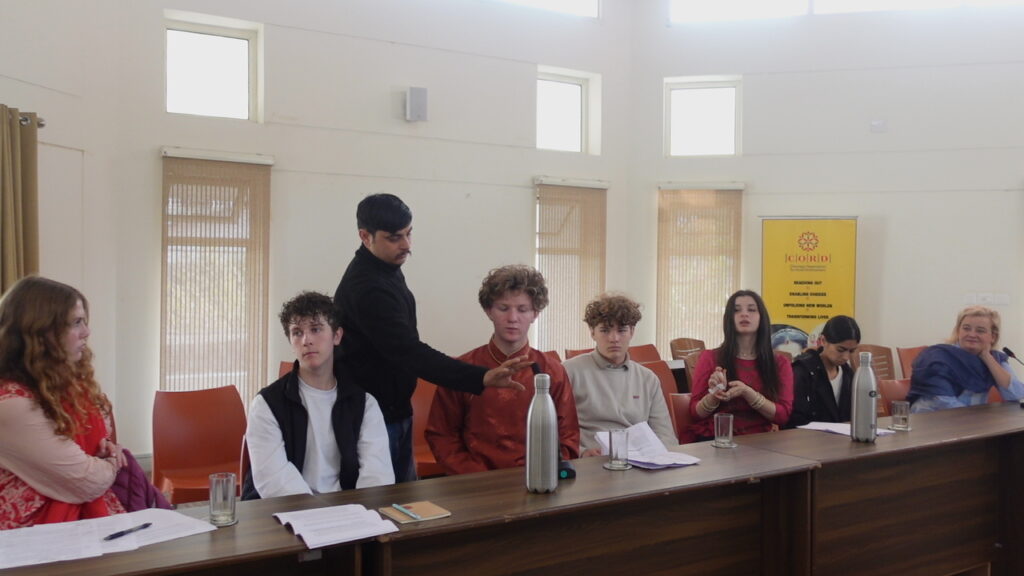
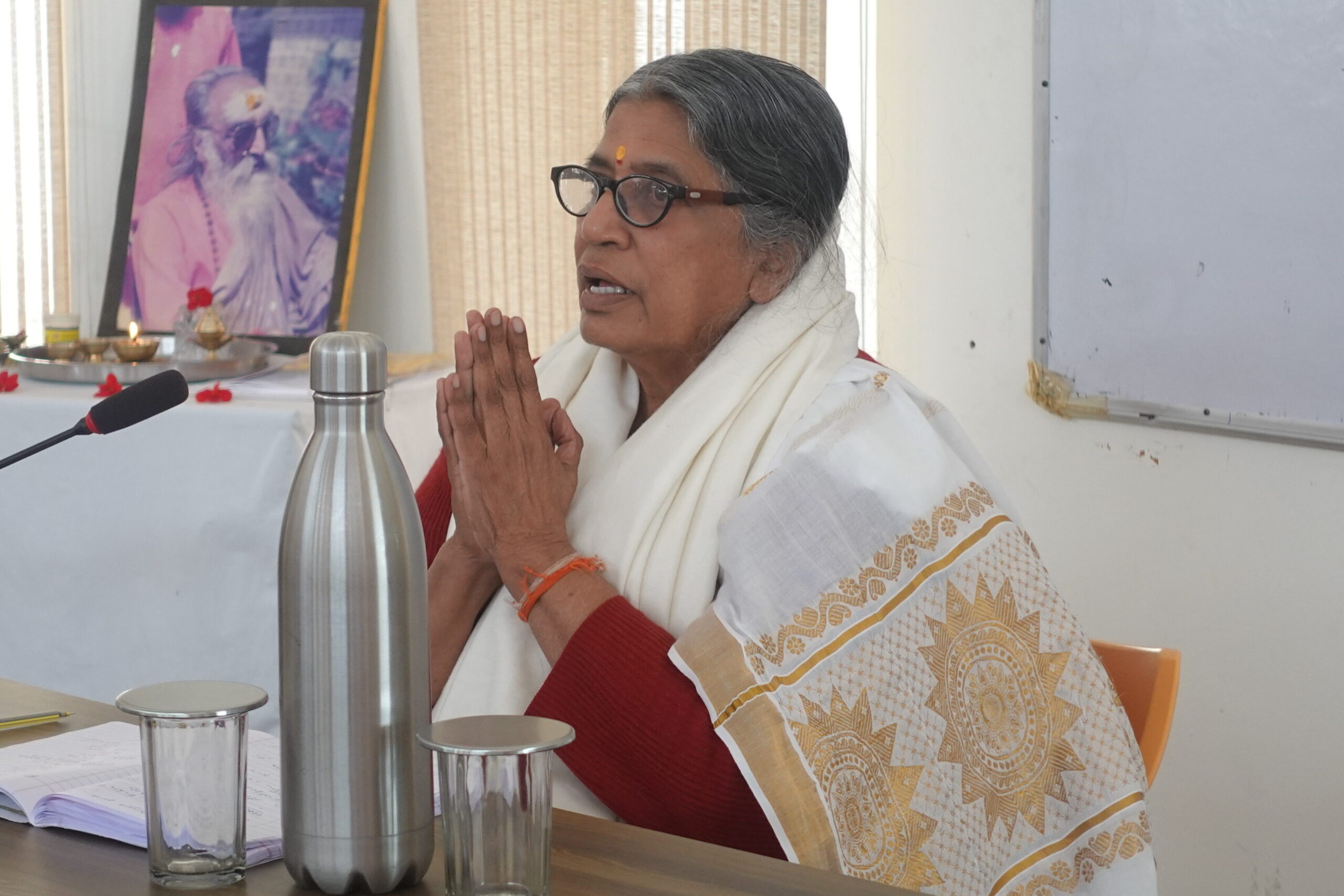
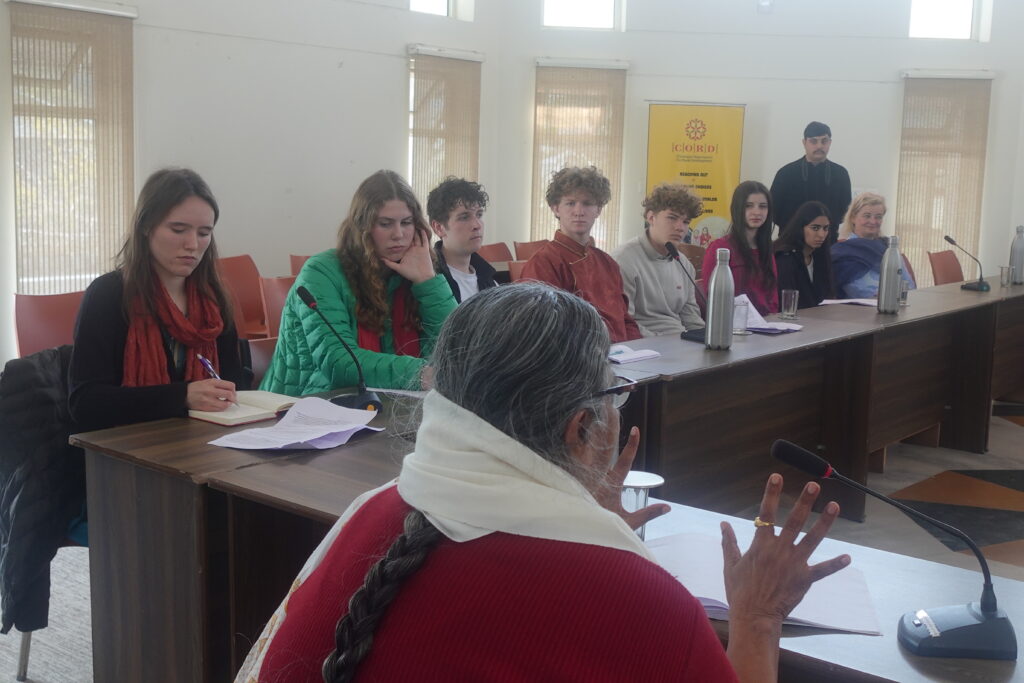
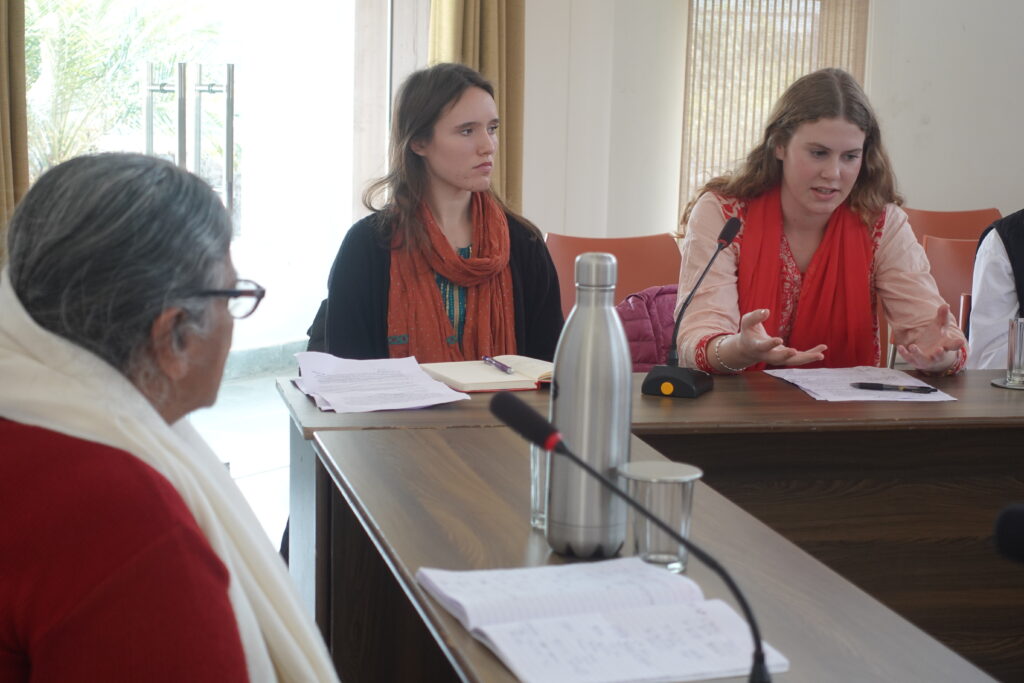
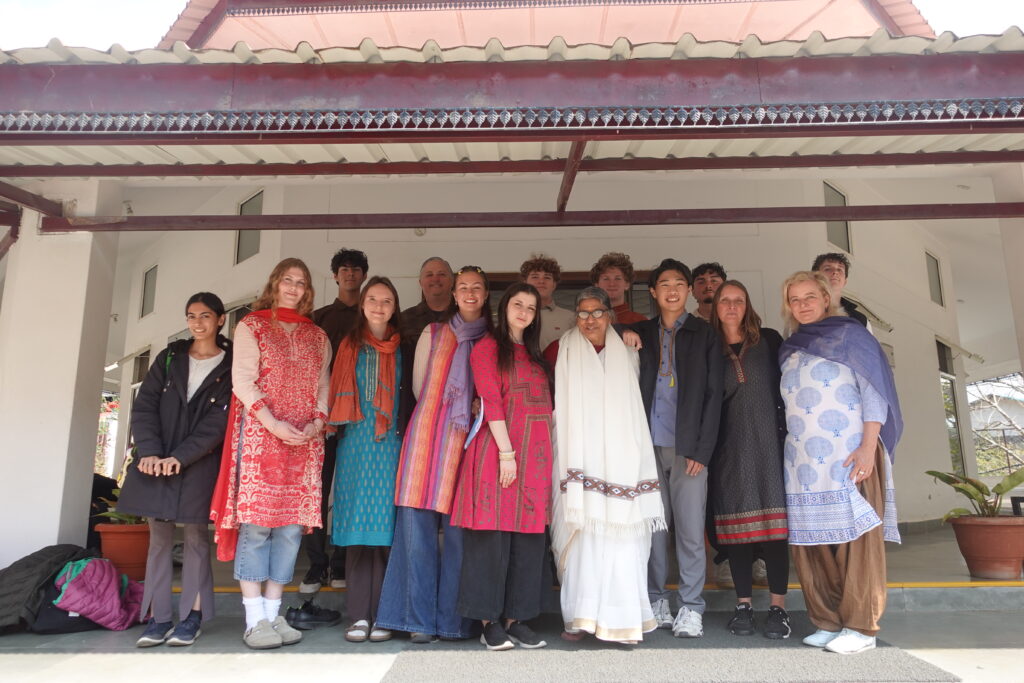
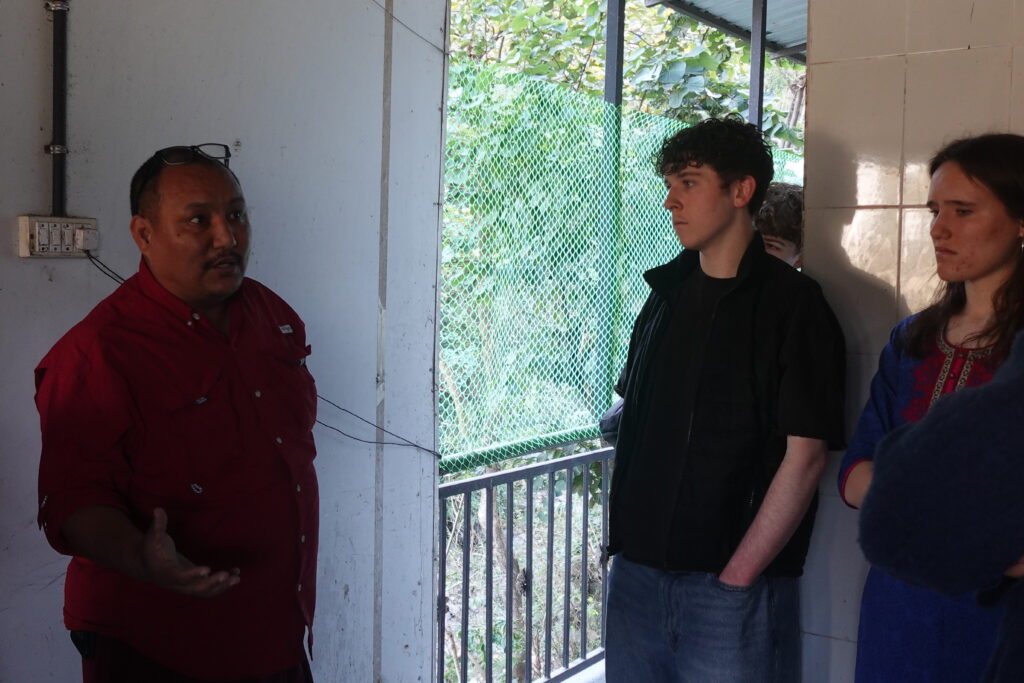
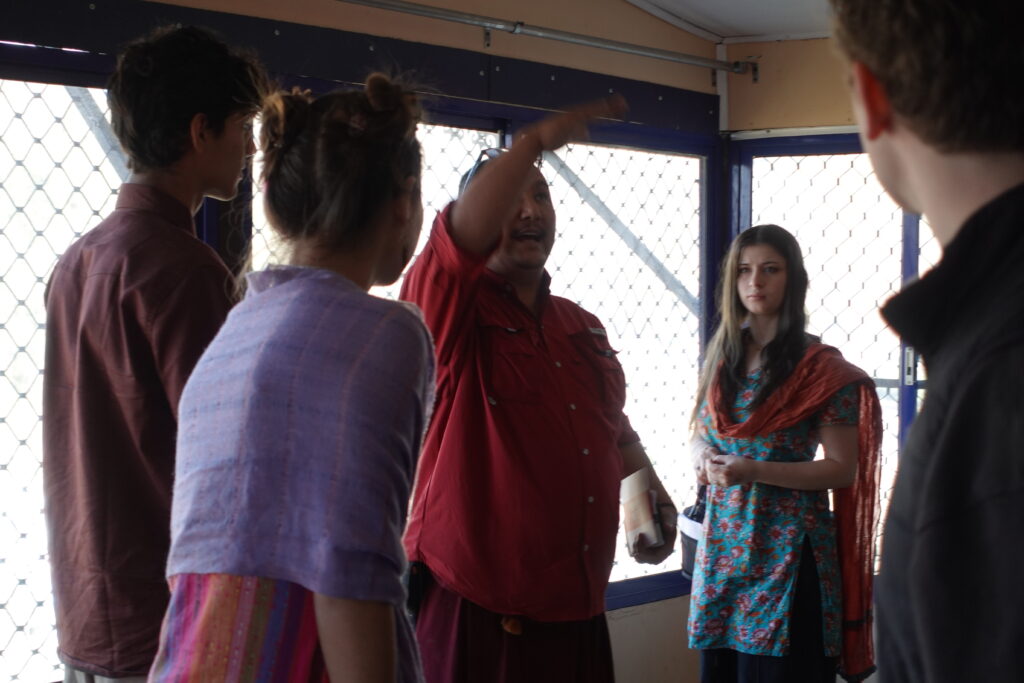
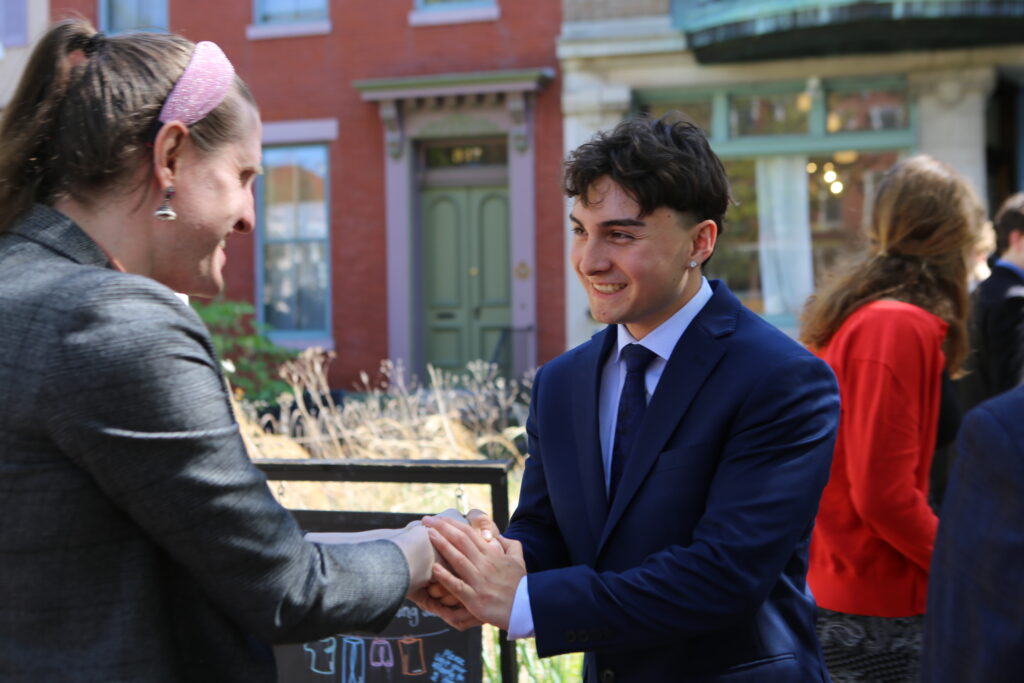
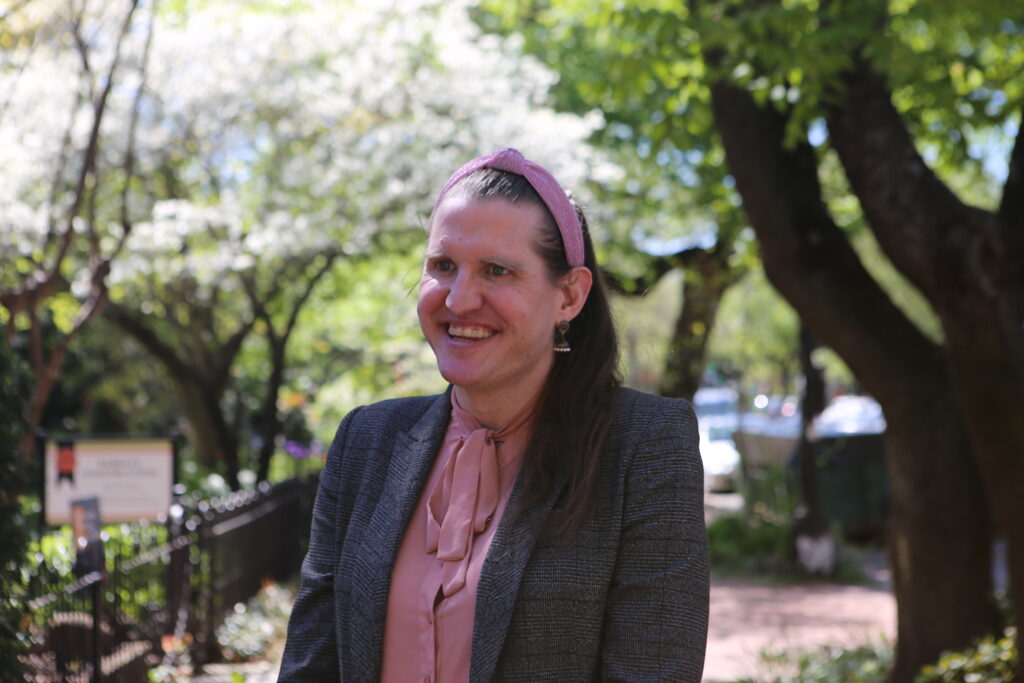
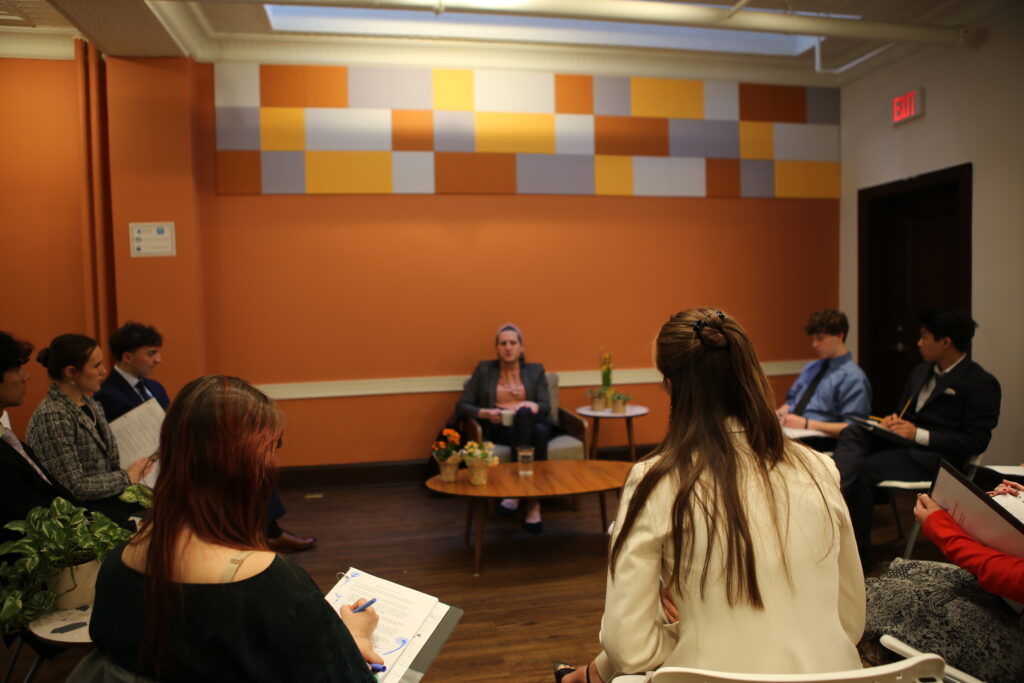
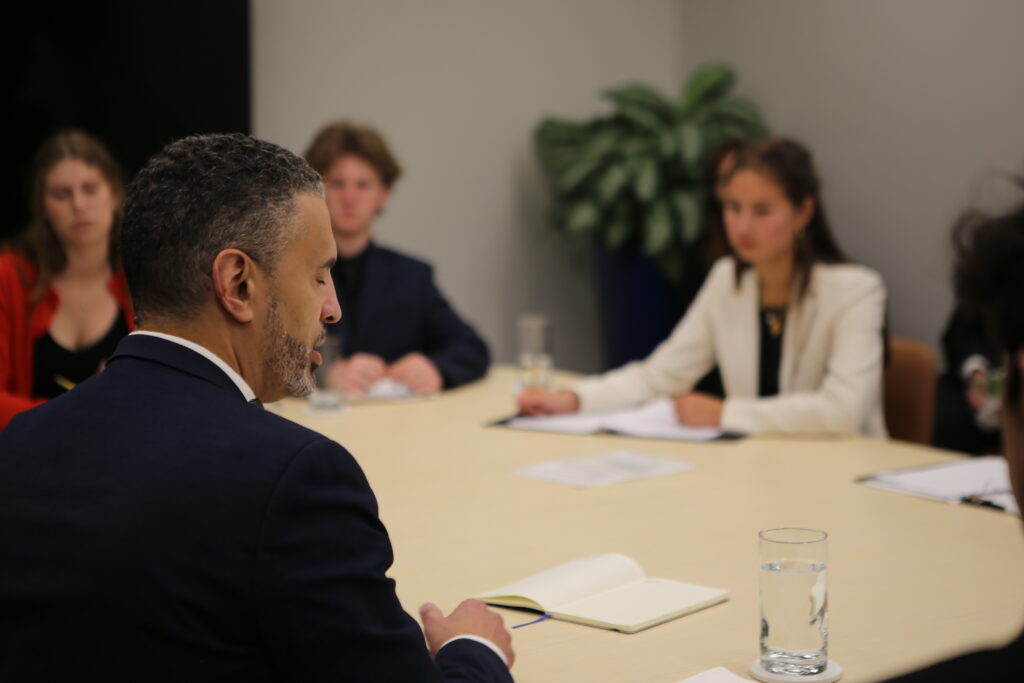
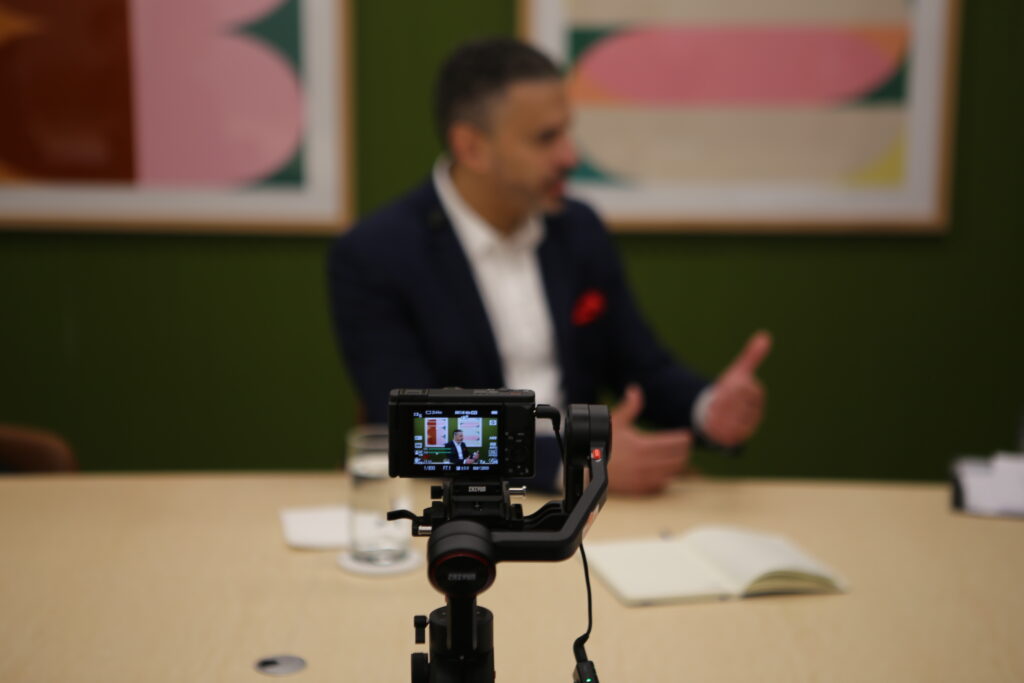
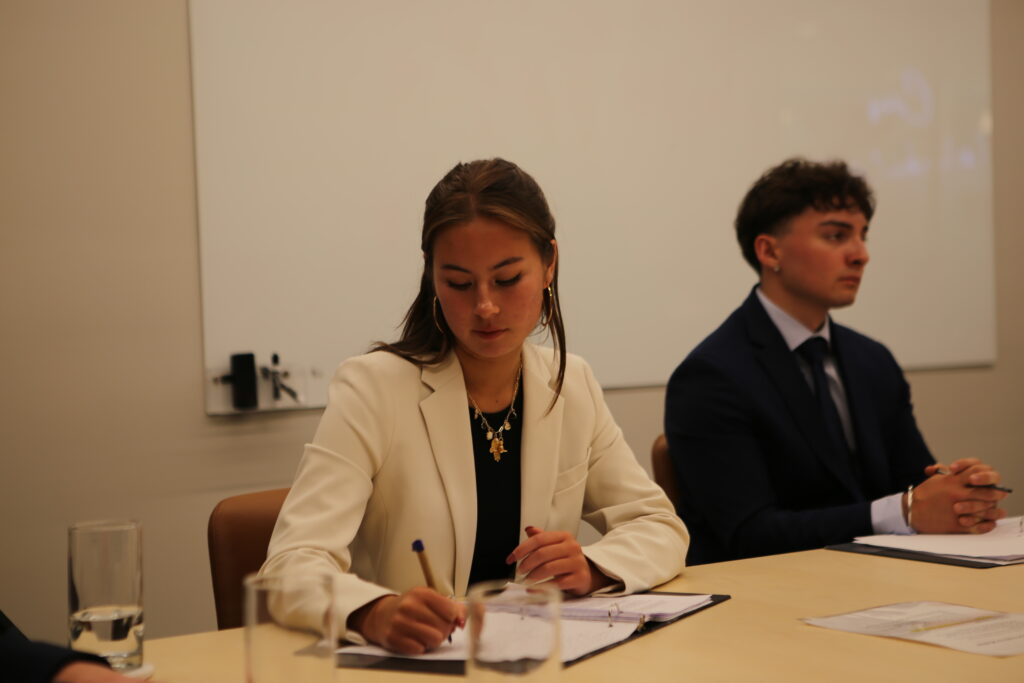
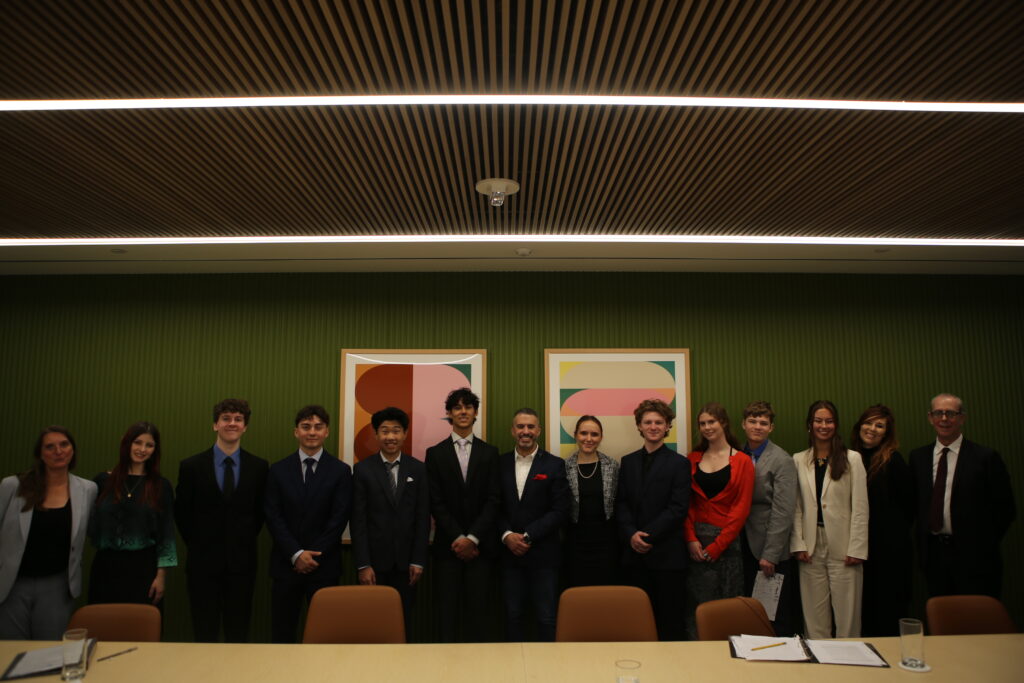
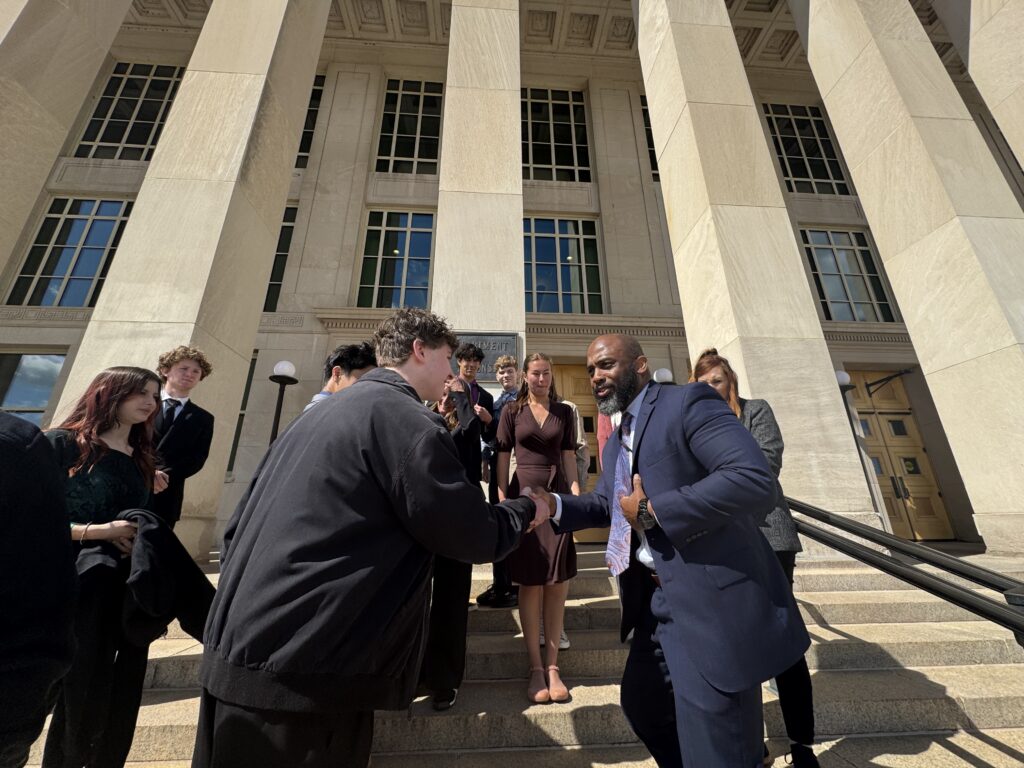
Today we had the privilege of meeting with Dr. Metre, an inspiring woman who serves as the director of CORD (Chinmaya for Organisation Rural Development). From the moment she stepped into the room, there was a noticeable shift in energy. We felt as though we were in the presence of someone who had not only seen and experienced much in life, but who had also practiced deep reflection.
Dr. Metre did not just talk about systems and structures, she spoke about people, communities, and the deeper values that shape how we live. She spoke about individualism in a context of negativity, in a way I had not heard about for a long time. When I was little, my brother and I would fight a lot about our toys and space. My grandfather would chastise us. “Mine. Mine. Mine. If you are always so focused about what’s yours, you’ll never know what more you could have if you joined your toys together.” He would always say this, no matter the context. He tried to teach us about unity over division.
I realized that over time I forgot about this, and was sucked into the individualism and independence of California culture. When Dr Metre spoke about individualism, I was reminded of many things I had forgotten. I remembered that I should be mindful.
By becoming independent, I lost connection to the things I could have had. I also became disconnected from my family. We praise independence in our culture. The minute we turn 18, we leave the house and go to college. From there, most Californians establish their own home. This is entirely different in India, where a normal path is to stay with your parents to help care for younger siblings. Then people care for their parents. While I don’t entirely resonate with either side, I feel like a good mix is necessary.
Rosemary Konviser
Inspiring Work
Today we interviewed Dr. Metre, director of the Chinmaya Organization for Rural Development. CORD is an organization built to empower people (especially women) in rural communities to become self-sufficient. The organization facilitates holistic well-being, community participation, and acquisition of modern business, medical, and agricultural skills.
Decades ago, Dr. Metre left her medical job and privileged life in Delhi to address health-related issues in the rural communities. Originally, this was the sole focus of the organization, but once she arrived, she realized that the health issues the people faced were interrelated with so many others that it was pointless to address them on their own. From there, the main focuses of the organization as it is today arose: women’s empowerment, healthcare, education, livelihood development, and community programs. This holistic approach was revolutionary and allowed for far greater empowerment and development than approaches that only address one issue, or treat people as only recipients of aid, rather than equal partners in their own advancement. CORD has become a model for other organizations trying to do similar work.
For CORD to be effective, people have to actually believe they have the power to change their lives. Because of conditioning from the caste system and the patriarchy, many often do not believe they have any agency or right to change their circumstances. An important part of Dr. Metres’ work is teaching women that they are important and their work is of value, and making them see that they are often actually doing more with their days than the men are. Giving women a platform to get together and discuss their concerns helps them gain confidence in what is often an isolating life of doing housework in their husband’s house, far away from their own families.
Apart from this work, Dr. Metre is also a wise and practiced spiritual thinker. Her commitment to CORD comes from her beliefs in service to others for happiness. We are all interconnected. She said, “If we value each other and each others’ roles, we begin to see that we are all complimentary.” She talked about how all you can change is yourself, but you can guide and help others, and by changing yourself, others around you will change. She said, “the greatest help I do to others is by changing myself to be the best human.”
Dr. Metre spoke of the body, mind, and intellect as instruments that we must take care of and learn how to use. To keep the mind calm, we must be able to watch what it is doing with alertness and awareness. We must also differentiate the permanent from the temporary. We are the witnesses of our own mind and we can learn to observe it and become separate from it and its fleeting emotions. Ultimately, we are all on this planet for a short period of time, and all we can do is share our prosperity, become one with ourselves, and do our best to help others. Dr. Metre said “the greatest purpose is to realize oneself, and to be one with the divine.”
Growing up, I knew about the Dalai Lama. He was always somewhat of a mystery. I pictured a mystical figure, and I knew he was the leader of Tibet. When preparing for this trip, we found out we were meeting the Dalai Lama, and it sounded cool but I didn’t really understand the significance until we got here.
I only realized how important he is after arriving in India and seeing the people’s dedication. I always thought he was powerful because he is the reincarnation of Avalokiteshvara (the bodhisattva of compassion), but what I have learned from being here is that his power comes from belief. I have never seen a leader with more devoted followers in my life. After seeing all of these people I was very excited to meet him and see for myself what’s so special about him.
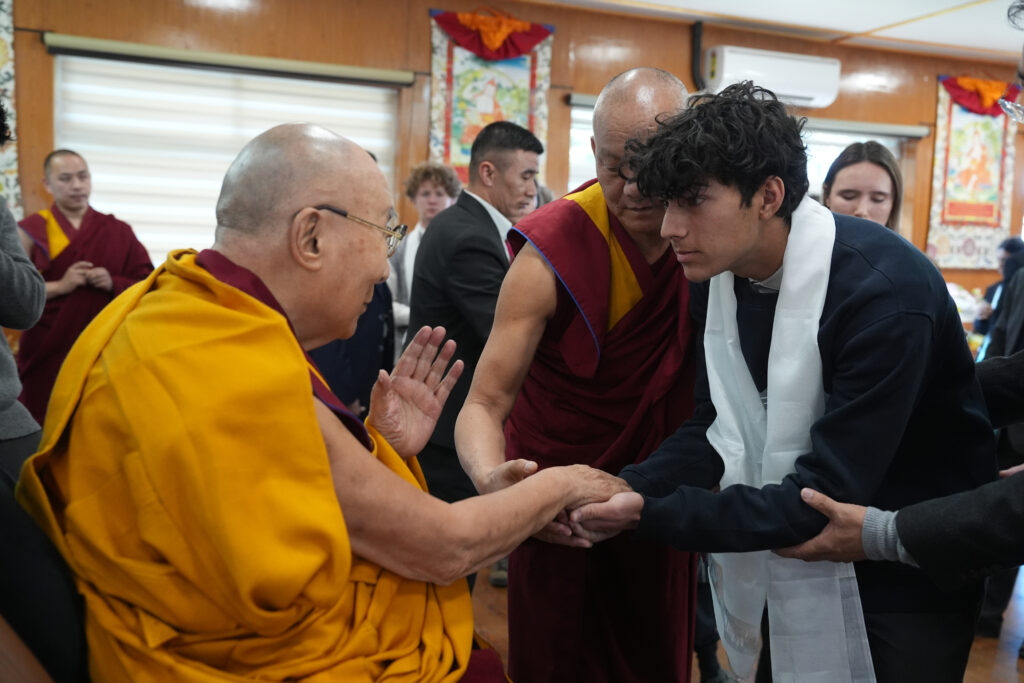
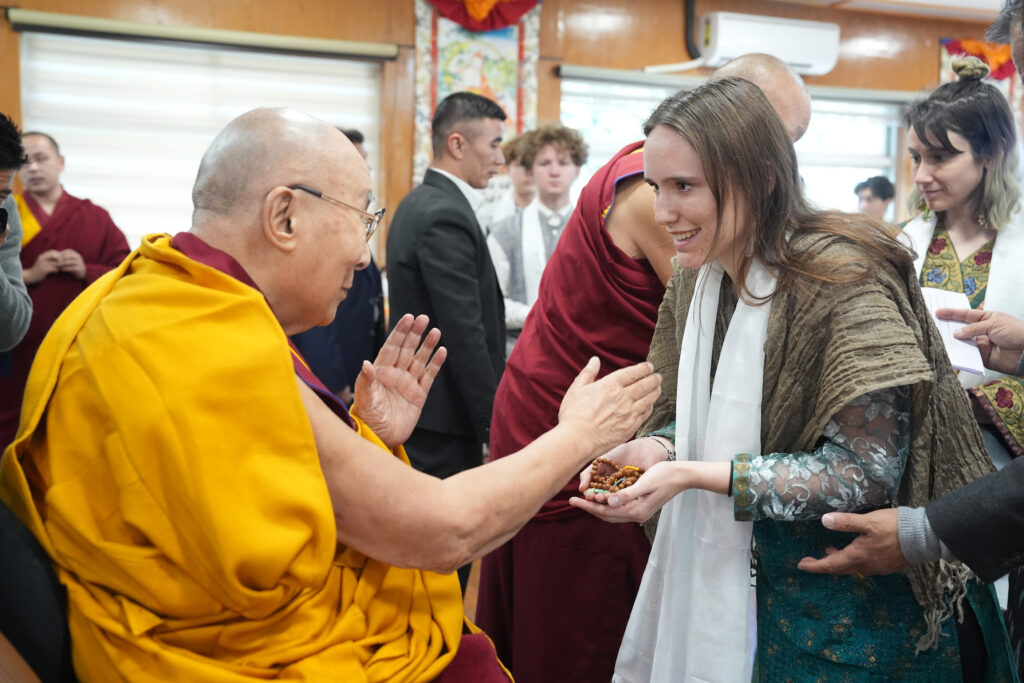
When we got there, I was excited and also incredibly nervous. We waited in the waiting room for a while before he walked in. When he finally did, everyone stood up and you could feel the reverence and respect that everyone in that room had for him. I was even more excited, but I was questioning what he was going to do that would be so impactful in the mere seconds that each person is allowed to be with him.
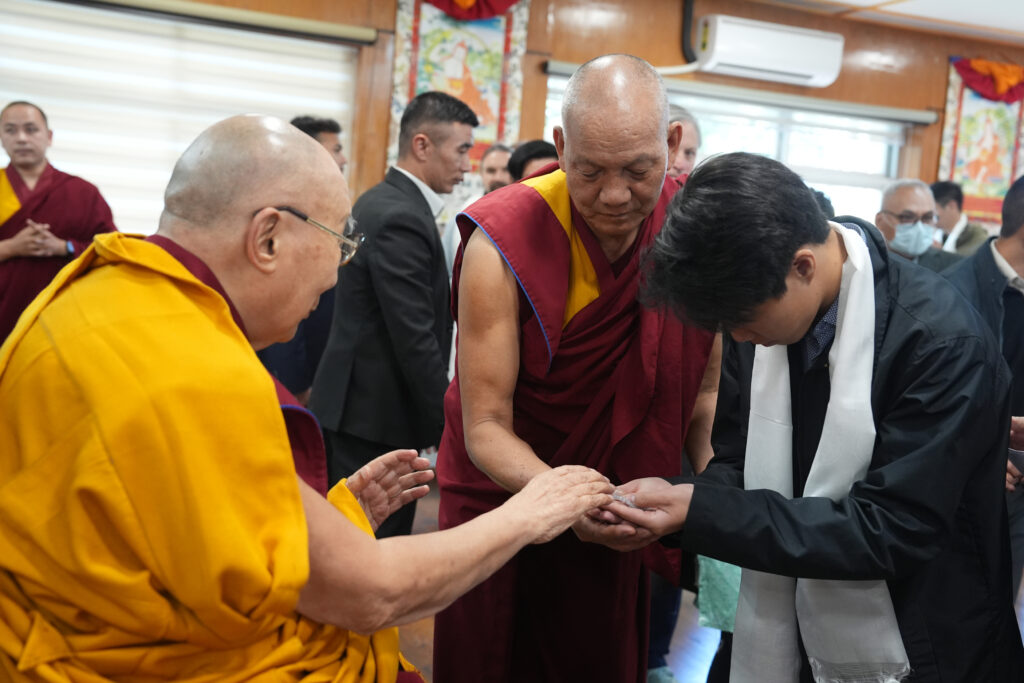
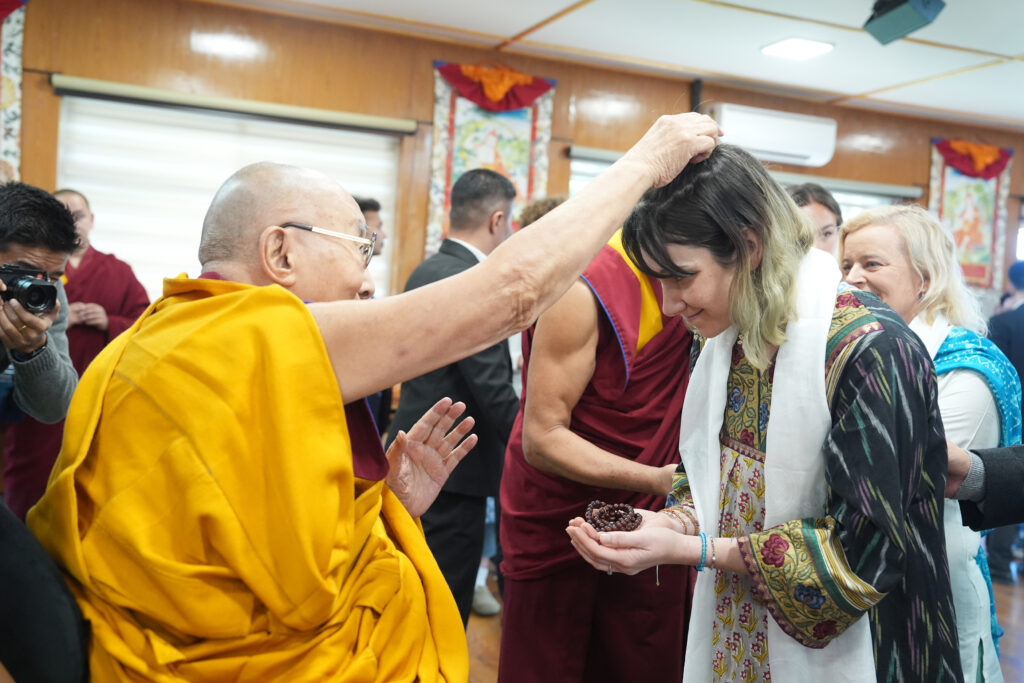
I finally made my way to the front of the line and I held out my hands to be blessed. This was one of the most simple gestures possible, but it still came across so powerfully. All he did was reach out and hold my hand and look me in the eyes for about two seconds. In those two seconds (I don’t really know how to explain it), I felt like he truly saw me. He just looked at me so calmly and intently that I felt like he really saw me in a way that I don’t think many people on this earth could ever see me.
This experience was something unlike anything I have ever been through, even though it was so simple. The feeling of his stare, his touch, and his obvious compassion and love is incredibly hard to explain. There is definitely more to my experience that I can not put into words.
Meeting the Dalai Lama showed me the true power that he holds and how all of the devotion that people have for His Holiness is fully deserved. I am truly grateful to be given this opportunity to understand a different culture.
Kyler Nishimura
An Exciting Morning
I have always had an appreciation for a great view, but after seeing the view from the top of the hotel we were staying at, I knew I would never be happy with any other view. While I could compare Delhi to a larger Los Angeles, and the countryside to Sacramento, the view at Dharamshala was unlike anything else I have seen before or am likely to see after. The closest thing I could compare to it is Grouse Mountain in Canada, but that does not seem even half as impressive. At Grouse Mountain, once you reach the high point, you are finished with the journey. Here in the Himalayas, the mountains seem to never end. When one stops, another begins, and there is an endless wall of snow capped peaks. Still, I was happy to head downhill from our high hotel today, even though the time was very early.
Today we would be meeting the Dalai Lama. I could not wait to see what would happen. This was because I was excited and nervous at the same time, and even now, I have the same reservations. The Dalai Lama is a very famous and revered person.
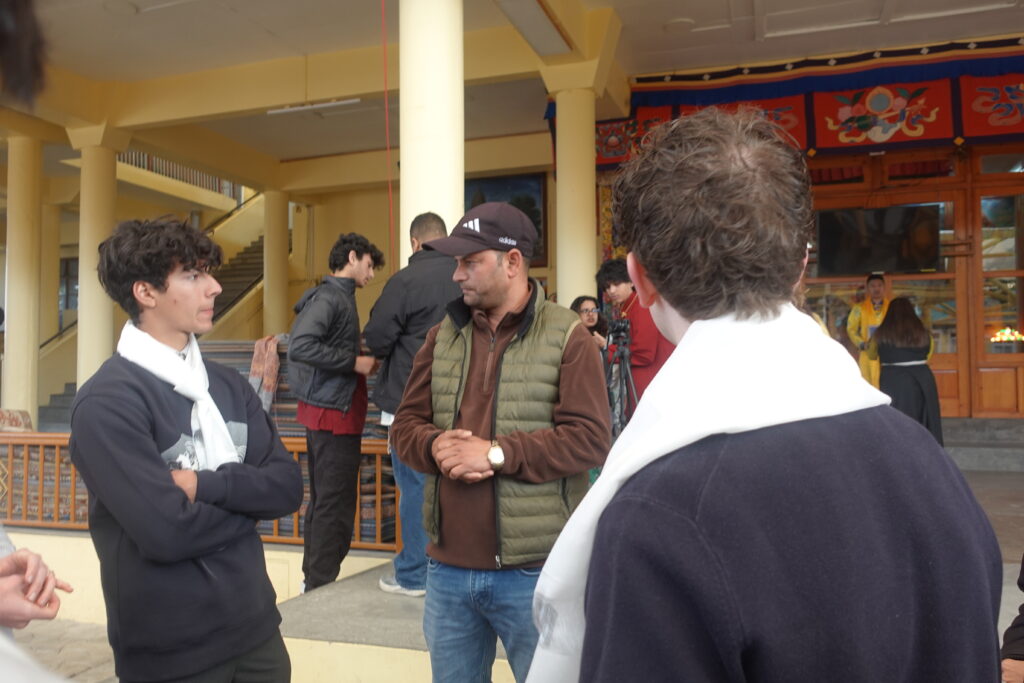
The walk was quick, and soon enough, we arrived at the Dalai Lama’s compound. The wait began. The wait was long, and at times I felt it would take hours, but I was surprised about one thing. I was still paying attention. I am, by nature, a person who is always thinking, and normally this takes the form of telling stories and remembering facts. This time, however, I was thinking only about the current situation I was in. I thought about who was next to me, who was in front, and how far I was from the Dalai Lama.
But soon, another concern hit me. I had not brought an object for the Dalai Lama to bless. Of course I had the scarf hanging around my neck, but everyone was getting their scarf blessed. I wanted something unique. Then I remembered that I had a friendship bracelet of beads that I got from a girl at the Ashram, and I knew that it was the object I needed. I quickly slipped it off my wrist, and my breathing soon returned to normal.
As I waited in line, two of the monks talked to me, and I was surprised by what they asked me about. One asked where I was from, and another asked about the bruises on my wrists, and I told him it was from a punching bag and not from a fight. He smiled at me and I continued on in line. Finally, the person in front of me moved, and it was my turn to be blessed. I extended my hands out with the bracelet inside of them, and I said “blessing”, so he knew that it wasn’t an offering. Then he closed his hands around mine, and just like that, it was over.
Overall, I’m happy with my blessing. Although I do not feel a major change in my life from the blessing directly, it has finalized my commitment to learning more about Buddhism, how to be a good Buddhist, and how to honor Buddha in my own life.
Chelsea Otterness
Encountering Holiness
“When you have nothing, you have nothing to lose.” — Bob Dylan
Easy for us to say. We have so much. Piles of things—more things. When something breaks, we toss it in the trash (perhaps after a few YouTube tutorials on how to fix it) and buy another. Convenience: a lifestyle that revolves around the purchasing of enhancements. That vacuum—while incredibly satisfying when it chooses to work—does not provide lasting contentment. It is temporary. It is fleeting. It is conditional: dependent on having a dirty floor, which is itself conditioned on having more things to dirty it.
Layer upon layer, our Western lifestyles amass these sediments. Layer after layer, they contribute to the mountain of “things,” of “stuff.” But what else is there? Another receipt? Another bill? Another metric to measure up to? To what end?
Our friends—brothers and sisters in humanity—fled through the night. They hid during the day, avoiding treacherous persecution from the “other.” They escaped with only the clothes on their backs, some prostrating for twenty-one days straight, callousing their foreheads and bruising their knees. Tomorrow was never guaranteed. Freedom existed only beyond the Himalayan range, in the haven of India. They carried nothing but an indomitable spirit, exalted by a generational heritage of faith in the interconnectedness of all beings. Faith that when they arrived—tired, cold, hungry, and alone—they would be received with kindness and make a home, albeit on foreign soil.
India welcomed these sisters and brothers from the land of Tibet, granting them refuge, supporting their autonomy, celebrating their vibrancy, honoring their religious ceremoniousness, donning their colors, and sharing in their devotional fervor.
How can a people persist in such joy as refugees? Perhaps the lesson is obvious, waiting to be received. Great teachers remind us that inner peace begins within. Maybe in extreme discomfort and material instability, the virtuous and resilient people of Tibet discovered an invitation to turn inward—to find their true home, their enduring happiness. Perhaps the less we have to pull our attention outward, the more direct the path to our compassionate hearts becomes.
When we sat in the waiting room this morning, awaiting His Holiness the Dalai Lama, everything felt ordained. A chaos so poised, regal, and beautiful embraced us like a warm hug. We waited together in tantalizing anticipation, hoping to be graced by his presence. He entered, ushered in by monks and devoted attendants. Group by group, we formed a winding, snake-like line. Each group was announced by its association and offered a brief but penetrating moment of his attention. His face—playful yet profoundly serene—lifted the fog from the sky.
Thank you, India, for sharing your mountains, your fields, your soil with the people of Tibet. Thank you, Tibetans, for persevering with utmost joy, color, and spirit. Thank you to the nations that cooperate so powerfully and publicly, showing us that peace between peoples can endure—that difference can be embraced, and that it makes us stronger and more compassionate as a species.
May our faith not rest in material things that fade, break, and clutter our sacred attention. May we look instead to these living examples of deep peace—of reliance on the intangible yet profoundly real force that binds us together in love.
Lisa Catterall
I was standing in a colorful, sunny courtyard rippling with people in all kinds of costumes and regalia, bright woven fabric and sleek embroidered silks, flowing robes of monastic and other traditions, well tailored western suiting and other outfits I can’t describe because they have no place in my experience of the world. There was a crowd of anxious people, all in their personal and cultural best, waiting at a small doorway to be called into the next step on the path to be blessed by Jetsun Jamphel Ngawant Lobsang Yeshe Tenzin Gyatso, His Holiness the Fourteenth Dalai Lama.
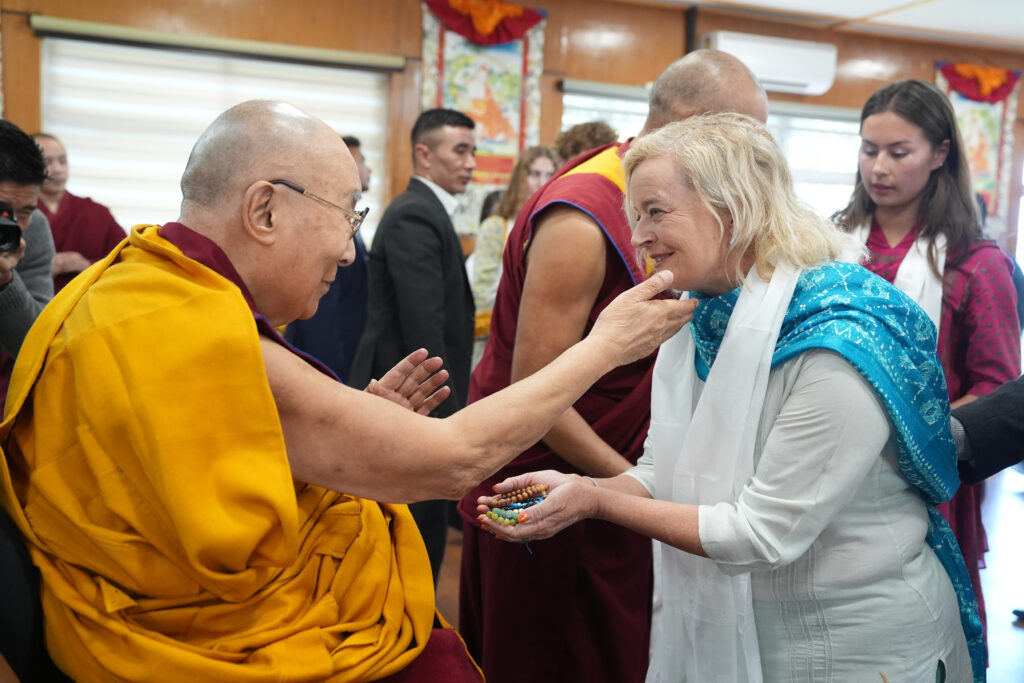
Buddhist believers think that the Dalai Lama’s are reincarnations of Avalokiteshvara, the bodhisattva (Demi-god) of compassion. In the two times I have been in the presence of his holiness, I have, indeed, found him to be the most compassionate person I’ve ever met. Fifteen years ago, in a long conversation, he taught me to love my enemies and to accept them as teachers. Today, as he looked deeply into my eyes and gently touched my face, I had the overwhelming feeling that he somehow understood the toil I endured this year, and in a way, the load I carried was instantly lighter.
I do not like organized religion. I do not believe in higher powers that can manipulate the minutiae of human experience. I deeply distrust the hierarchy and structures of major religions, knowing too much about their history. I do, however, firmly believe that there is much magic, and myth, that exists beyond the current explanations of science. We will explain it someday; we haven’t yet, but we can feel and describe and know it in the present. I believe that His Holiness has magic about him. Perhaps it originates in the difficult circumstances he has faced in his life, or in the years and years of meditation, dedication to others, and study that are required of him. Or perhaps it has arrived in the probability field between gluons or in the travel of the undiscovered particles at the vertices of E8, or perhaps Tibetan Buddhists are correct. In any case, his magic is as real to me as the chana masala I had for breakfast.
High Lamas in this area are beginning, I hear, to have visions about the birth of the next human body that will carry the bodhisattva of compassion. They have indicated that the fifteenth Dalai Lama is likely to be a westerner, and she will be born in a female body. I wonder, if she accepts the honor, how she might change the world.
While I stared at a giant painting of the Potala in Lhasa (the palace that has been the residence of the 5th-14th Dalai Lama’s, and was so until the Chinese conquered Tibet), I could not help but wonder how the structure of a religion convinced people to build such an enormous palace. Did they toil in the sun for little or no pay, promised that this was a path towards enlightenment? Weren’t Mecca, the Vatican, the Golden Temple, and other centralized religious seats much the same? I looked it up. While not slave labor, the building of these places does not, entirely, fit the doctrines dictated within. I am fascinated by the active ritual held in these places when they seem like they should be museums.
The thoughts I wrestle with are rampant in the modern world. The Dalai Lama was interested in Mount Madonna’s Values in World Thought program and first invited us for a conversation 17 years ago because he believes that secular schools hold the future of moral and ethical teaching. New generations are turning away from organized religion in record numbers. Schools will have to take up the teaching of ethics, in his opinion, and our Values program is a shining example of this. The program asks students to explore and define their own morals and ethics without dictating or indoctrination. The juniors and seniors read, discuss, sample, and question thought leaders from around the world as part of the process.
Rosemary Konviser
Compassionate Presence
Being in the presence of such a revered, practiced, and wise spiritual leader was both impossible to wrap my head around, and simple at the same time. There was a deep sense of humanity in the room; dozens of people making their way towards the Dalai Lama, in tears, humility, joy, gratitude, and other deeply human emotions. The Dalai Lama blesses around 600 people every day, so I almost felt guilty for being there. I wondered if he would be tired of doing this. Somehow, the opposite was the case. This was not a celebrity overrun with fans and tired of giving autographs. This was a joyful being, living a life of compassion and service, and choosing to connect with others in a beautiful way each day.
I didn’t know what to expect from my moment with the Dalai Lama. I tried to watch his interactions with the people in front of me, but somehow, even in this crowded room, he still seemed to have a personal, private, present moment with each individual. He is 90 years old and blesses so many people every day, and yet I gathered after the experience that he had blessed each member of our group in slightly different ways, making us all feel truly seen individually. The experinece was amazing. He made us feel like we were not just another face in the crowd.
The word that struck me about my meeting with him was gentleness. His gentleness removed all signs of aging, worry, or anything else apart from the moment we shared and the simplicity of it. We looked into each other’s eyes and I felt humbled by the gentleness in the lines of his face, his smile, his sparkling eyes.
I continue to be struck by the Dalai Lama’s health and kindness after living through a life full of hardship. He truly practices what he preaches in the sense that happiness can come from within and from service to others, regardless of the circumstances and the suffering we go through. The Dalai Lama is so inspiring, not because so many people follow him, but because he is a living embodiment of a beautiful ethical system that brings out the best of human nature. The themes of compassion, connection, and happiness despite suffering, have been prevalent throughout the trip, and meeting the Dalai Lama solidified all of these experiences into one awe-striking, moving moment.
Gage Saul
An Entourage of Gratitude
The hotel where we were staying was very close to the Dalai Lama’s palace, which made everything feel more immediate. When we finally got to visit this palace, there were many other foreigners nearby. Clearly, people had traveled far just for the chance to see him, even briefly.
The security was much stronger than I had expected and envisioned. We were told to bring almost nothing. No phones or cameras. The restrictions felt intense, stricter than when we once visited the Pentagon. Every entrance was monitored; we saw armed security on the balconies. Every movement felt very controlled by the Dalai Lama’s assistance. At first it seemed excessive. The level of respect surrounding him explained it. He received many gifts.
There were so many people who simply wanted to see him in person. I was surprised; before, I had not fully realized how respected and important he is within Indian culture and across the world. The admiration was visible in the careful preparation that took place before his arrival. The Dalai Lama is very well cared-for. The attendants spent a noticeable amount of time preparing his space. They positioned his chair carefully so he could sit with ease. Many minor and small adjustments were made for his comfort. This experience taught me the importance of cultivating, and earning, respect.
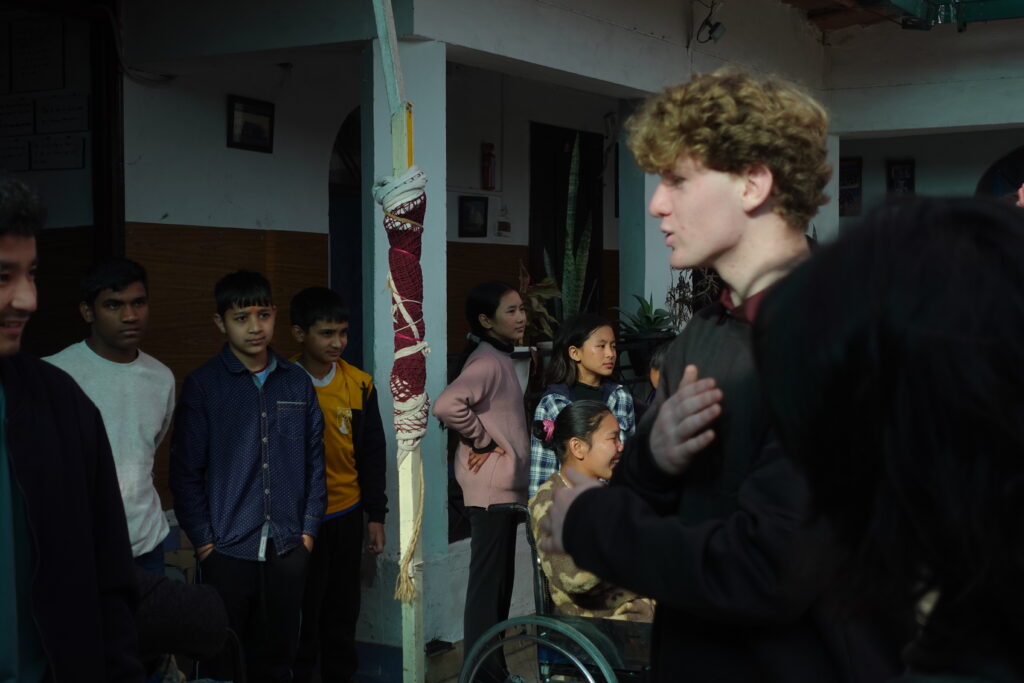
Today we visited C.E.D. Society, which is run by the monk Lama Tenzin. We met a group of kids who had all been rescued by Lama Tenzin at some point in their lives, and who were brought to live and get an education here in Dehradun. Lama Tenzin focuses specifically on rescuing and educating young girls, often from rural villages in the Himalayas. A big part of the program is giving the girls an excellent education and teaching them about womens’ health. The caste system has left damaging prejudices on not just the poor population in India, but specifically on women and those with disabilities. Girls, especially those in rural areas, are not looked at for anything other than a dowry and what can be gained from their arranged marriage, and therefore it is not considered worth it to educate them. They are not valued members of the family in the way that sons are. The majority of the kids we met at C.E.D. Society were girls, and some of them had been abandoned by fathers who wished for sons. Lama Tenzin explained that mothers who birth only daughters and no sons are shunned and seen as bad omens. We learned that those with disabilities are also seen as bad omens.
In the Hindu tradition, reincarnation is seen as a reflection of actions from past lives. Those born into low castes or with disabilities are taught to believe that they deserve their circumstances because of sins from past lives. This belief often keeps them from trying to improve their circumstances. I was inspired to hear Lama Tenzin talk about the changes he’d seen in the girls since they’d arrived. He described how they now believed in themselves and had confidence, whereas when they’d lived in the villages, they were taught to think they were worthless and only valuable as wives.
Lama Tenzin uses his power as a monk to change narratives and to reverse stigmas. There is stigma around being near those with disabilities, but it is also known that it is bad to not listen to a monk, so Lama Tenzin has power to shift these prejudices. Using this power, he convinced people to help him rescue girls in wheelchairs who needed help trekking out of the Himalayas, even though there is stigma around touching the disabled.
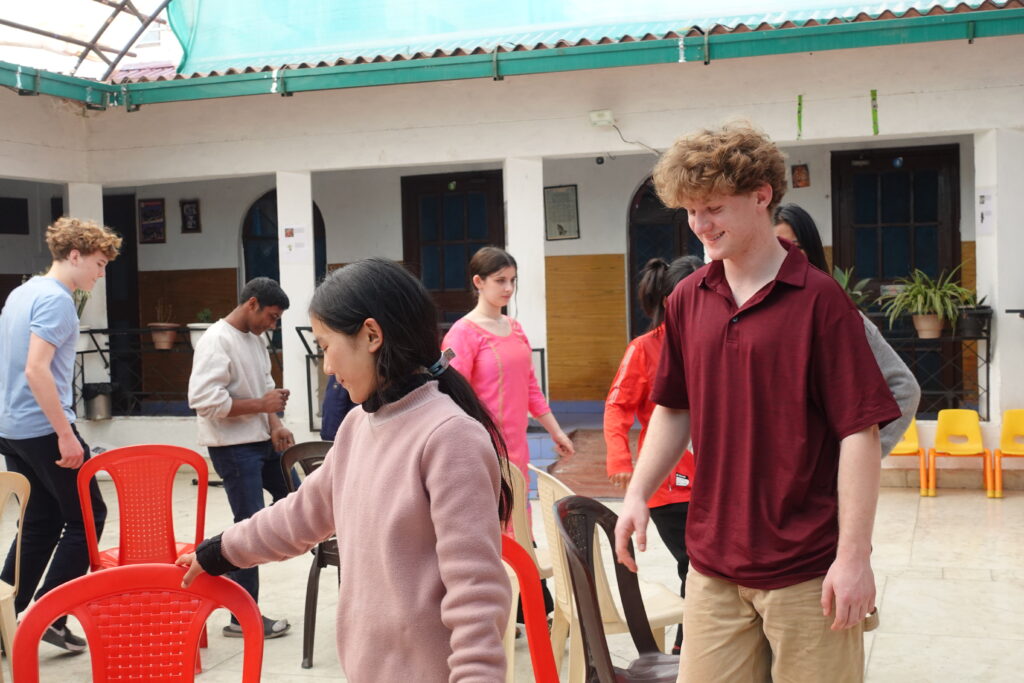
Meeting these kids, you honestly wouldn’t know that most of them were orphaned, abandoned, or abused. It was a striking experience to interact with people who have gone through things we couldn’t even imagine, and yet have the biggest smiles on their faces. Each child was simply happy to be there, happy to see us, and eager to take us by the hands and play, sing, dance, and talk together. I was surprised to see how much we all had in common.
We talked afterward about smiles and play being the universal language. We talked about how no matter how different the little things are, in the bigger picture, we are all so deeply human and painfully similar. We all formed close bonds immediately. We bonded over Ed Sheeran, table tennis, and Polaroid photos. What we didn’t already share, we introduced one another to. All expressions were of welcome and kindness and I felt my fear of meeting new people fading away. Throughout the day, I felt extremely humbled. Seeing the childrens capacity for pure joy and kindness even amidst hardship forced me to reflect on my life. I am deeply inspired by the children’s positivity, creativity, and zest for life. If these kids can be this happy no matter what has happened in their pasts, then I can shift my perspective and approach the challenges I face at home differently. They truly embodied the idea that happiness comes from within and we are the truly are the masters of our own suffering.
Mateo Borrego
Think Pink (pads): Menstrual Activism
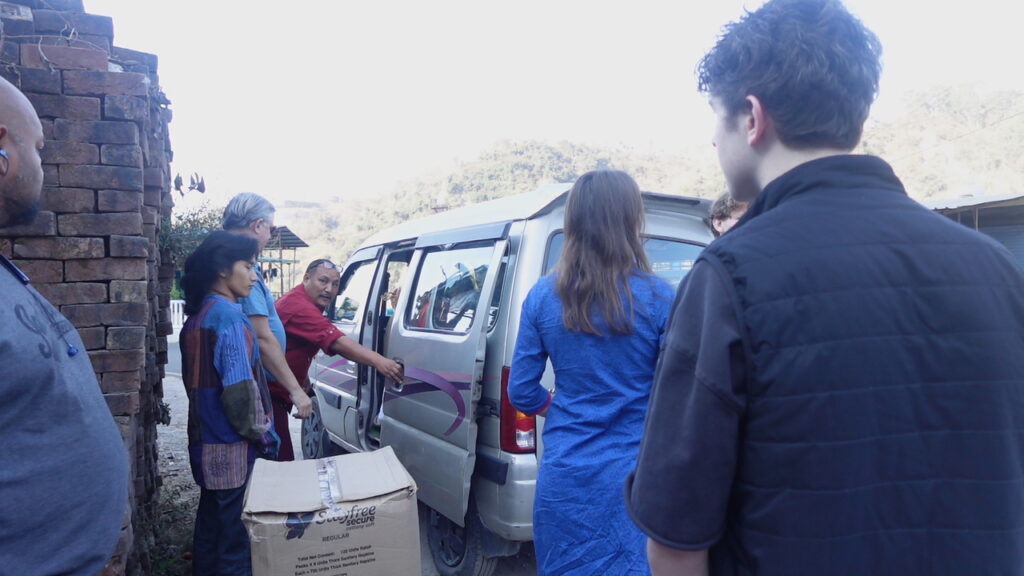
Today we went with Lama Tenzin to his Pink Pads facility. On the way, we had to get out of the bus and transfer to Lama Tenzin’s car because the bus is too big to climb the steep hill and manage the narrow curves up to the building. I thought it was very interesting how fast the lama would go through these winding roads, narrowly avoiding people, animals, and other objects. He was completely unbothered and remained so calm throughout his driving. It made a big impression on me.
Enough about this ride. Pink Pads is an organization that makes compostable, high quality menstrual pads and gives them away in remote villages in the Himalayas. Because menstruation is considered dirty and there is a stigma among the local people, Pink Pads also digs holes so that when the women are done after use they throw the biodegradable pads in the pit to compost. We got the incredible opportunity to take a tour of the facility for Pink Pads and it was a moving experience. Seeing how much Lama Tenzin has achieved and how much he does to help was inspiring, and he is just beginning the work. In the facility, there are many floors and he showed us what was on each one.
There are rooms for people to stay, study, and work; a manufacturing floor, offices, a sewing area, and even a helipad on the roof. What was really interesting is that he said that he would offer free lodging and food for anyone who stays there and also that he would give jobs to any woman who needs them. He plans to allow flexible schedules for his workers. When you get married in India, all the money usually goes to the husband. The women do not work because they are supposed to take care of things in the house. They can not work eight hours, which is what most companies require. I think Lama Tenzin’s understanding of the situation shows how good of a person he is and how much he really cares. He takes the time to understand peoples’ struggles, then looks for ways to help. I found the experience of meeting him and hearing about his work truly inspiring. I was amazed to be able to spend time with such an amazing person.
Gage Saul
Monk of Compassion in Action
Recently, there was an opportunity to visit CED in India. The experience has remained difficult to fully put into words. Lama Tenzin was introduced as someone deeply involved in supporting underprivileged and often marginalzed children. His pace stood out immediately. He moved quickly between conversations, activities, and responsibilities. There was little pause. Attention shifted constantly from one person to another.
Lama Tenzin explained the circumstances of many of the children. Discrimination based on class and background has shaped much of their early lives. That reality felt heavy when it was described, yet the atmosphere itself did not feel heavy. We played light hearted games. Energy filled the space almost instantly. Athletic ability became obvious without much effort. Some of them were faster, more coordinated, and more competitive than expected. Laughter broke out frequently. At times it was loud and chaotic. At other moments it was quiet and shared between only a few. Encouragement came naturally, almost automatically.
Their beginnings had been difficult, but what appeared in front of us was confidence and connection. Belonging was noticeable. It showed in small gestures and in the way they stood close together. It showed in how they waited for one another. There was teamwork, but also independence.
The contrast between their past hardships and their present environment was striking. Reflection did not happen all at once. It came later. Questions about community surfaced gradually in my mind as I contemplated the day. What does meaningful contribution actually look like? Is it large and visible, or something less obvious? Observing Lama Tenzin complicated those assumptions. His work is not dramatic. It is repetitive. It is constant. He listens. He responds. Then he moves on to the next person. Service, in this setting, did not appear abstract. It looked practical. It looked ordinary. It required attention.
Compassion, especially when viewed up close, tends to carry a different weight. The visit did not resolve anything neatly. Instead, it left thoughts about responsibility. Change may not arrive in a single moment. It may build slowly, almost unnoticed, shaped by steady commitment rather than sudden action.
Lennon Smith
Gratitude and Lifting Up Others
We started our third day in India with a visit to Pink Pads, Lama Tenzin’s start-up focused on mass production of affordable, compostable menstrual pads for marginalized communities. As he works to get the equipment fully up and running for production, he is also raising awareness in the surrounding area and creating employment opportunities for women of all backgrounds.
One group he is particularly focused-on is the women who live near the building and rely on their husbands’ earnings. By employing them, he is putting money directly into their own accounts, giving them financial independence and the ability to make their own choices.
The care and consideration Lama Tenzin brings to his work are so evident and truly inspiring. From the CED Society to his numerous other projects, such as Sound of Soul, his dedication to uplifting others is remarkable. I feel incredibly fortunate to have met him and to see firsthand the impactful work he is doing. He’s also bought out a smaller plot of land diagonal to pink pads where he will build a connecting building for Sound of Soul, a music studio for underprivileged and disabled kids.
The first few days of this trip have been so amazing that I couldn’t even begin to express my feelings about them in words. Being able to travel the world has always been a passion of mine but it means so much more than that. I’m eternally grateful to my mom for working to give me the privilege of traveling like this.
Hans Hagge
CED Society Play
When we arrived at the CED Society, we began playing almost immediately. We started with games like rock-paper-scissors and Wild Wild West, and then some of us moved on to chess.
I played with two young children, and then I played with someone my age. I was surprised by how good they were because, if you know anything about chess, you know that learning it without access to a computer or a good teacher is difficult.
Then we all played basketball and ping-pong together. I taught a girl in a wheelchair some piano and played while she and Lucy sang. It is inspiring that, despite her difficult situation, she still laughs and acts with kindness. We then played musical chairs three times. I was impressed by how we just kept moving from one game to the next. Back home, when we play games, we usually stop after just one. I was also thankful to the CED Society for giving these kids opportunities they wouldn’t otherwise have.
I feel like if we brought more play into our lives in the US, everything would be a lot better. Currently, it seems that many kids in the US don’t play games very often. When I was the age of the children we played with, I never had full days of play. Instead, I mostly worked on activities like piano, and when I did play, I usually only touched one or two games at most. I never played longer than two hours. I was expected to learn, not play.
In the US, many families expect children to spend their time doing things that will help them in the long run and are seen as productive. At the CED Society specifically, I saw kids playing all day with us, which I have never seen in the US. More often, we are too busy with piano, school, and other skills, while playing is seen as less productive or even a waste of time because it doesn’t lead to income.
But play is valuable because, for kids, social interaction is a huge benefit. You are going to need social skills throughout your life, and they are extremely helpful in many situations. I feel that I missed out on a lot of social interaction in my younger years because my school wasn’t really focused on play, and there wasn’t much time to do fun activities. In the culture of my school in the US at the time, there were small social groups and clear social levels, with some people being more popular than others. Play is something that removes those social levels and makes everyone equal, with the same goal: to win.
Last night we had dinner at a beautiful home in Dehradun. Our hosts had invited a diverse group of leaders and spiritual pilgrims, and they asked us to introduce ourselves one at a time and tell the group about a moment when India had made an impression. Keep in mind that we had only been in the country for two days. I said something in the spur of the moment. The more I let it sit, the more I realized it increasingly resonated with me. This is the story I told.
Growing up in the same household, in the same city, with the same experiences for 18 years has led me to look at the world in a certain type of sheltered way. Of course, having access to the internet and other people’s stories has allowed me to gain a vague understanding of the extent of my privilege, but that only went so far. My privilege was something intangible, far away, and hazy.
Growing up, I thought that I had smelled all there was to smell, seen all there was to see, and developed the worldview I would carry for the rest of my life. That wasn’t the case at all. Of course, it was arrogant to think this way, especially because I knew I had only seen a fraction of the world.
The second I left the airport and stood in New Delhi, everything I had assumed shattered. We had talked about letting go of our assumptions in class previously, but I never expected it to be so drastic. Actually experiencing the contrast to my small, sheltered life was overwhelming. I thought I knew how cities were laid out, and then I encountered Delhi. This sprawling metropolis was bustling, and so energetic that I believe even a seasoned New Yorker would be overwhelmed by it. Immediately, without even trying, Hans and I began counting things that were foreign. We could not look out the window of the bus and find something that was not new to us. I admit this was our way of clinging to familiarity, and eventually I gave up counting, as I realized it would be more efficient to count something that was familiar instead. Additionally, after only two days in India, my worldview has profoundly altered. With ten more days on the ground in this country, I think that this is only the beginning of India’s impact on me. In order for a trip to be truly life-changing, it is not just your external beliefs that change, but the ones you hold dear at your core, the quiet assumptions you didn’t even realize you were carrying.Maybe I haven’t seen all there is to see after all. Maybe I’m only just beginning to notice how much I never understood in the first place.For now, I’m learning to stop counting what’s different and start paying attention instead.
Cora Kayne
CED Society
Today, our class visited the Children’s Education and Development Society (CED Society), which hosts a number of children from different parts of India as well as Tibet. Most of these children have a horrific origin story. Many forced to work very early in their lives. Some were ostracized in their home village because they had a disability, or they were excluded from education simply because they are female.
Each child has their own unique story, and when I stepped into the homespun comfort of the CED Society walls, I was excited to learn about each and every one.
I spent the most time with 2 girls named Pema and Hema, both of whom were disabled. Pema was instantly welcoming and kind, similar to her fuzzy brown pajamas with a bear print all over. I talked to her about her life at the CED society, as well as her hobbies. She told me that she enjoyed singing as well as piano. She sung a song for me which was beautiful, and then we sang a song together.
I felt very connected to Pema in this moment. I felt the joy of communicating through music. One thing that I noticed over and over at the CED society was how creative everyone was. Despite the circumstances in which these children had arrived in the world, they all still found a way to create music or art. One child named Khushi couldn’t speak or hear, yet she danced with great enthusiasm and accuracy. Other children loved to play the piano or the guitar. Lisa brought bright colorful Disney pens, and each child was excited to use them and showcase their drawings of things they love. Donuts, and dogs, were the most popular.
Going into the CED society, my first goal was to treat these children like my literal and immediate friends. I did not want to seem like I was just being friendly because I wanted to be a good person or because I was forced to bond. I genuinely wanted to connect and be friends with these children and form an actual friendship. I believe I did that, and I am grateful that we have a chance to return today and cement the bond.
Lucy Yen
A Gift for the Elders was a Gift to Us
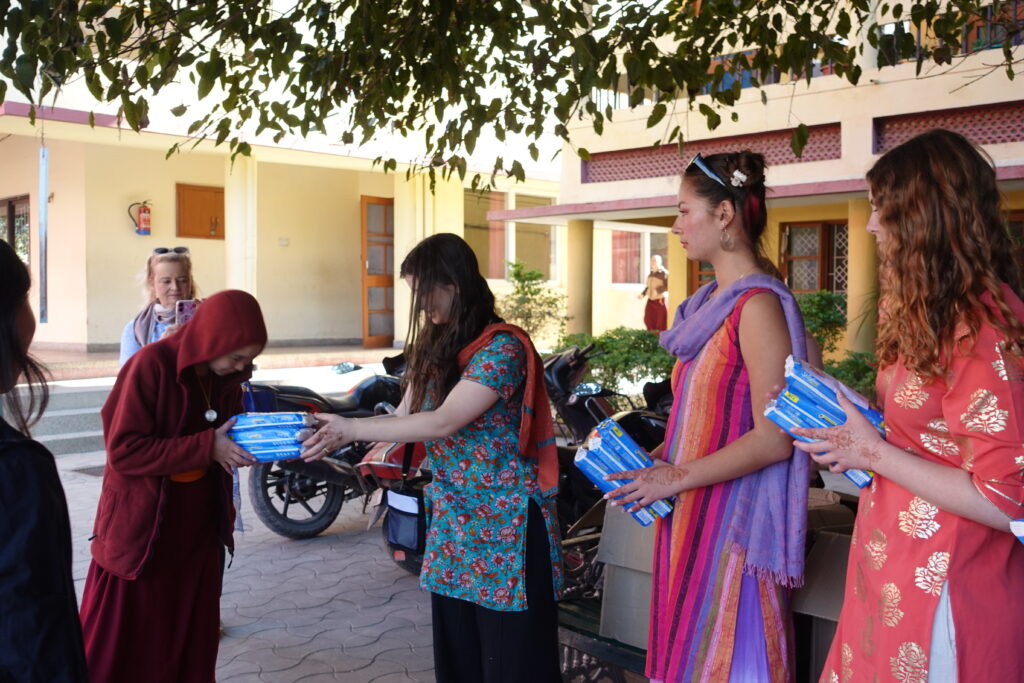
After spending all day playing with children at CED society, we went with Lama Tenzin to distribute warm hats and socks to some old folks living in a local home for the elderly. Immediately upon arriving I was struck with the stillness and tranquility of the home. It was really quite a contrast to the rest of the day.
Everything about India is bright, loud, busy and overwhelming; this is even more true in the childrens’ home where we had just spent our day. A pocket of peace and reverence, however, was created for the inhabitants of the home for the elderly.
Methodically, Lama Tenzin gave us each clear instruction on how we should hand out the hats and socks. He was careful to show equal consideration for the quality of our experience as well as that of the elders. We created a procession line of sorts, as the elders walked down the table we each handed them an item while bowing our heads as a show of respect. It was a simple exchange and a simple experience, with the sole purpose of distributing the items. After distribution we waved goodbye, got scolded at by Shannon for making eye contact with one of the monkeys playing on the surrounding walls (it’s a sign of aggression), and left.
What I affected me most about this moment was the truth in the experience. The scene is: a bunch of privileged, western children, handing out clothes and money to elders at an old folks home, most of whom are Tibetan, under the guidance of one of the most self-less people on the planet, Lama Tenzin. I initially felt panicked that there might be offense taken at our gesture, any thoughts of pity or “this is just charity.” However there was none of that sentiment echoed by these elders, nor was there overwhelming emotional gratitude, just ceremonious acceptance.
As I reflect on my initial feelings and then the truth of what really happened, it’s quite clear why there was such a discrepancy between the two. These elders felt no shame about accepting our gifts, because no shame was required of them. Their life and wisdom earned them our kindness, care, and reverence. The truth I found is that in our western, individualistic society, we do not treat our elders with nearly the same level of respect that most other countries do. A respect that was palpable in this home. It was crystal clear to me. From the way they manage to create a peaceful haven, to the ceremony Lama Tenzin had us create just to hand out some clothes and money, there is a recognition of these elders and their experience. I saw clearly how important it is to make people feel valued, especially towards the end of their life. These elders, no matter what experiences they’d gone through in their life, or ailments they had, still shone with such joy. I don’t think that is something you see often in homes for the elderly in the west.
The whole experience was a beautiful reminder of what is possible for elders. If a country with as many people as India, who are all very different, can create a sacred and peaceful space full of reverence, imagine what is possible for us.
Today was our first day in India. We landed at the Delhi airport at around 6am, so our first look at India was the sunrise over New Delhi. All of the things that I heard about India were on display: the smells, the amount of people, the crazy drivers and all the animals roaming the streets. It was truly incredible.
We went straight from the airport to a five hour bus ride to Dehradun. Even though it was just a bus ride, I had an amazing time and I loved getting to take it all in from a bus window before it engulfed me. I got to just sit in the bus and listen to my music and look at all the wonders passing by.
For me, the most impactful thing I saw was the sheer amount of homes in Delhi. It is the most populated place on the planet but you don’t really understand what that means until you see it. There are an extraordinary number of homes and people everywhere.
After taking in all the views for a couple of hours, I started playing road trip games with my classmates. The games were a lot of fun and a good way to enjoy our time on the road.
After arriving in Dehradun and getting all checked-in, we went straight to the AASRAA Trust and met hundreds of kids who are sheltered and fed there. We talked to groups of them at a time. We got some insight into their lives and we told them a bit about ourselves. I enjoyed getting to talk to the kids because it gave me a good introduction to the hospitality and excitement of the people here. We watched them perform some songs and dances which were very impressive. Then it was our turn, and we performed a song and a dance for them from the Ramayana. After wrapping up at the Trust we headed back to the hotel and had dinner.
Today we interviewed Charlotte Clymer. She is a very cool person, and she really illustrates the importance and power of community.
She talked about how a sense of community has made her realize that having solid values is important. I think this is an interesting concept, and it inspires me to participate more in my community and in activities around me. Another thing she said that I find interesting and that has changed how I think is that when I have arguments or conversations with others I should “take a step back and ask if I’m wrong, even if I think I’m completely right.” It’s important to consider if I’m wrong because I expect others to do the same, and if I’m not willing to do so then I can’t expect others to do so either. This is a powerful idea that I had never thought about before, and it makes me want to be more mindful of what I’m saying and recognize that the other party in an argument might be right, and even if they aren’t they still deserve that respect.
Near the end of the interview, I asked her a question about a drink, the French 75, which I found out from an interview online is her favorite drink. The name sounds like it might have some military history, and I learned that it does, as the drink is named after the French 75mm gun. I asked her if she had looked up the history of the drink, and she said she would look more into it. It was one of my favorite moments of the interview because the way she reacted to the question was so funny.
All in all, the interview was amazing, and she said many extremely interesting and important things, and I hope to talk to her again one day.
-Mateo Borrego
Who Am I to Decide That I’m Going to Quit?
Today we spoke with activist Charlotte Clymer. This was the last of our eight interviews, and it felt like the perfect culmination to this incredible week and brought us back to many themes that have been consistent throughout our interviews. I thoroughly enjoyed speaking with Charlotte. She is very educated on the history of social movements. She was also incredibly interested in what we had to say and gave us really thought provoking answers. Just as important, she was hilarious.
Charlotte served in the army for six years, and has since become an activist for LGBTQ+ and feminist rights. As a trans woman and activist in DC who also is religious and grew up in a conservative part of Texas, she has always had a very complex relationship with her identity. I wanted to ask Charlotte about patriotism, because I was curious about what it looks like to perform a deeply patriotic act for your country while also protesting that country’s prejudice towards a marginalized group of which you are a part. Charlotte made it clear that it is possible to do both, and she gave us examples from history. She said that the greatest act of patriotism is being there when your country needs you, and prioritizing your country and Constitution over the prejudice you’ve experienced in times of need. She explained that you are serving a higher purpose that this country is worth defending despite its imperfections.
A theme that we’d brought up in our interview with Linda Ryden is the dangerous idea of cancel culture, and our society’s inability to give someone a second chance when they make a mistake. Charlotte brought this up on her own, telling us she doesn’t believe in cancel culture. She explained that there’s a difference between making mistakes in good faith and bad faith, and that sometimes people just don’t know that they are doing the wrong thing. Additionally, it is crucial that we be able to step back and consider for a second that we could be wrong, because it is what we are expecting the other person to do when we disagree, so we need to give them that same grace. Another theme that came up is the power of difference. Charlotte said, “The way we get better as a country is by noticing nuance and complexity in each other.” Learning to work with people different from us or who we don’t agree with is a crucial ability. The first step is actually recognizing that there are differences so that we can see what everyone can bring to the table. This is crucial, even if we don’t always agree, so that we don’t have blind spots as a society. She explained that it is unhealthy to say things like “race is just made up,” or “gender doesn’t matter,” because it minimizes the importance of our fundamentally unique perspectives. In doing so we are ignoring the truth that we are all different, and we need to use those differences to form a good society.
A theme that had come up talking with another activist this week is that change is slow. Charlotte had a lot to say about this, and I found her views to be inspirational. Referencing the famous quote, “plant the seeds for the trees whose shade we will never enjoy,” she made it clear that you must keep fighting for a future you may not be around to see. Her view is that we have a responsibility to the generation that comes after us because the generation that came before us felt they had a responsibility towards us. Especially as a woman, it’s important for me to remember that many people fought their whole lives to give me the rights I now take for granted. I owe them a lot, and so I owe it to the next generation to do the same thing they did. In other words, it’s about something much bigger than me. As Charlotte said, “Who am I to decide that I’m going to quit?”
-Rosemary Konviser
The Importance of Intention
Charlotte Clymer was the last interview we had in DC, and let me just say it was a great way to end our interview experience. She is very unique. She is from Texas, she is religious, and she has been in the military, but she is also a transgender woman who works as an activist in DC.
Charlotte’s main theme that she kept going back to is intent. She talked a lot about how intent can change the meaning of a mistake. For example, while talking to us she made the mistake of using someone else’s catch phrase without knowing its origins. Although this was a mistake that she could be criticized for, she simply apologized and realized that she had done wrong. Her point is that this was a well-intended mistake: it was not made in order to harm somebody else. This is different than if she wanted to use the catch phrase in order to gain success, especially if she had already known its origins.
I was struck by how she thinks about how other people think. I asked her, “Do you think the rapid progress in LGBTQ+ communities and awareness in the last twenty years has led to the mass hate and criticism it’s facing today in political spaces?” She said yes, that a lot of people who disagree with LGBTQ+ are usually well-intended people, but they have become ashamed at not understanding LGBTQ+ people. Of course, this isn’t always the case, but it’s important to remember that some people are confused and ashamed of their lack of understanding, and they are not fully able to sit with the uncomfortableness of seeing someone different from themselves.
It’s obvious to me that Charlotte has lived through different variations of identities, since she is both understanding and compassionate to those who are different from her. It was great to hear from someone so educated and full of understanding.
Licy Do Canto speaks with clarity and humility, and it seemed that he spoke not to seek attention but connection. Listening to him reminded us that leadership is not about status but about service and self awareness.
He began by stressing the importance of being yourself. In a world where many feel pressured to fit in or perform, he reminded us that our greatest strength lies in showing up as we truly are. Authenticity is not only powerful but necessary. He also reflected on how each generation often believes it is living through the worst of times. While the challenges are real, this perspective can cloud our ability to see hope, to act, and to move forward. History shows that change is possible, but only if we believe in it. He also emphasized that true leadership means helping others become better people. In doing so, we help create better leaders. Listening, he said, is at the heart of leadership.
A thoughtful speaker must first be a thoughtful listener. He spoke about vulnerability, especially in spaces like Washington, DC, where it is often scarce but badly needed. People crave honesty and real connection. Being open is not a weakness but a strength. He also noted that we can learn much about a person by the company they keep. Surrounding oneself with wise, thoughtful people leads to personal growth and better decisions. His message was clear: being somebody is not about titles or applause; it’s about showing up with purpose, honesty, and heart.
-Gage Saul
What Divides Us Is the Thing That Brings Us Together
Before going to DC, when we were assigned people to research, I was assigned Ray Suarez instead of Licy Do Canto. I got so busy researching him that I didn’t do much research on Mr. Do Canto. That would change the night before we were assigned to interview him, as I was able to do some research and write a question that Shannon complimented. It was the highest compliment I would get about a question the entire trip, and it made me excited to talk with him.
The next day, we went to his office building, and as we were waiting outside, he found us. My first impression of him was positive. He seemed outgoing and very interested in us. When we finally got to the meeting room and he began speaking, he was very talkative and friendly. He had a lot to say about religion, our potential as young people, how he was once in our shoes, and his background and career. He talked about how walking Ted Kennendy’s dog was “the most important job I had ever had.” He also talked about Walt Disney’s original deal with NBC to make the point that you need to deal with challenges in order to achieve success. Walt Disney had been rejected many times before he made the deal with NBC, but he eventually became incredibly successful. He also talked about how he was taught by his mentors to never repeat himself in a conversation, and how he got a job working for Rep. Barney Frank after an interview that lasted only three and a half minutes. Finally, he talked about the current situation in this country and stated, “What divides us is the thing that brings us together.”
-Kyler Nishimura
Shoot For the Stars
Of all the brilliant people we interviewed, Licy Do Canto was the most excited to talk to us. He said that he saw himself in all of us and felt strongly we were all the same, but that he is just “a bit further down the road” than we are. He spoke a lot about what was fulfilling to him and what really matters to him. He spoke passionately about providing opportunities for young people and supporting and lifting up those in need. When asked how he feels about running for a position of power in this country, he replied, “The highest privilege I could ever have is sitting in front of you.”
A common thread running through all of our interviews is the power of community and human connections. To be honest, before coming to DC, I pictured the city as intimidating and full of self-important people who prioritize their own personal agendas over everything else. However, what I’ve found to be true is the complete opposite, and the interview with Mr. Do Canto really confirmed that view. He has built his career in DC on connections. He advises interesting people who know other interesting people with whom he can connect, and the network of interesting people grows wider. He stated, “It’s important to have inspiration in one’s life, to be around people who inspire you to be better than you ever thought you could be.”
Talking with Licy was the first time I could picture myself sitting in the chair he was sitting in. Throughout the week, and as we talked to more people, I have been falling more and more in love with the idea of living in DC. The connections people build, the things they are able to accomplish, and the success they can achieve through the resources the city provides is impressive and extremely tempting. The good in DC is so good, and I love the idea that I could be a part of it. He also stated that “vulnerability in this town is in short supply and high demand.” It’s exciting to think that I could be someone who brings that sort of vulnerability to DC, that I could, as he said, “be in places where I can contribute in a significant and impactful way.”
He also talked a lot about going as far as you can with what you’ve been given in life, to “embrace the opportunity to contribute with the talents [God] gave you.” Finally, he talked about a mentor he had growing up who told him to “shoot-for the stars,” beyond local policy and government, and move to DC, where he is now in a position to be the person who connects us with other star-shooters and impressive people doing amazing things in this amazing city.
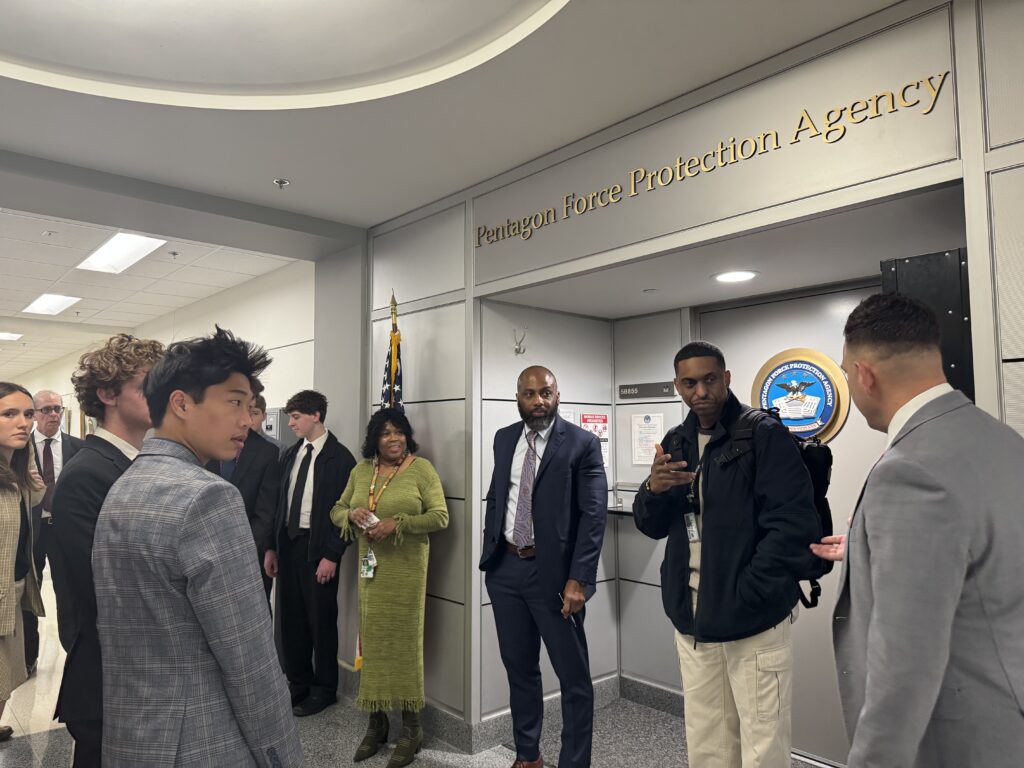
Before today I had no idea what the Pentagon is or what it is for. I just thought that It was a strangely shaped government building that did some very important things. From the second I first stepped into that building I was shocked at the range of people who work there. There are many people doing different and very important tasks that help our country to function and to remain safe. Seeing so many people doing so many good things in one place gave me hope for our country because it showed me that the American people can find ways to work together no matter how different we are as long as we have a common goal.
All the people that we talked to while in the Pentagon were so true to themselves and their mission, and it was incredibly inspiring. Officer Jackson, the person who set up our visit, is a retired army soldier who now works at the Pentagon Force Protection Agency, the police force at the Pentagon. He said his goal is to help as many people as possible no matter what that entails. He said even if it is just giving someone directions while on patrol, he feels satisfied that he has done his job.
We also interviewed Officer Jackson’s boss, the agency chief. He said his purpose is to provide resources to his staff to keep people like Officer Jackson ready for whatever they have to deal with. Helping others is what makes him feel he is doing his duty and fulfilling his mission. Finally, we talked to a NBC reporter, who works at the Pentagon and has reported from combat zones. She said that even though her job is sometimes dangerous, the benefits that come from bringing the truth to the people of America justify the risks she takes.
In general, I was impressed with the pure resolve that the people who work in the Pentagon exhibit. They have given me a little more trust in the government and shown that even in this difficult political situation there are still a lot of people in government doing a lot of good.
-Nikowa D’Costa-Hemp
A Surprising Realization
Today we went to the Pentagon, where we were given a tour by Officer Jackson.
When I started the day, I knew nothing about the Pentagon besides that it is somehow related to the government. We talked to a number of people, including Corey Walton, chief of staff of the Pentagon Force Protection Agency, and a NBC correspondent. Until today, I had only seen the government and military as depicted in TV shows and movies, usually portrayed as hard, rough people. However, what I saw today was completely different. Corey’s enthusiastic presence and obvious love for his job lifted the room. He explained his job in a way that made me think I would love it too if it were my job.
Before visiting the Pentagon, I thought joining the military seemed like you were just giving away your life and independence. However, I now see that joining the military is not really like that; it’s willingly choosing to devote your energy and life to a greater good. Every military member I talked to was genuinely excited and interested to talk to me, and more than happy to answer any questions I had. I learned a lot, and I left the Pentagon with a newfound interest, as I’m now seriously considering joining the military airforce (Sorry, Mom).
-Lennon Smith
Our Visit to the Pentagon
Our visit to the Pentagon was a mix of formal and informal, which was unexpected. As someone who likes a comfortable work environment, I never imagined that working there could feel like a viable option.
Our morning started early with us getting dressed in our suits and gathering for breakfast. We were all excited as we rode the Metro. We had to follow the routine security procedures like those at an airport. Belts, jackets, phones all went into bins and rolled through the scanning machines as we passed through security checks.
Our guide for the day was Officer Jackson from the Pentagon Force Protection Agency. We began by entering an office, leaving our devices behind, and engaging in an insightful conversation with Corey Walton, the Chief of Staff of the agency. Corey shared anecdotes of his work and the ways in which individuals attempted to break Pentagon security.
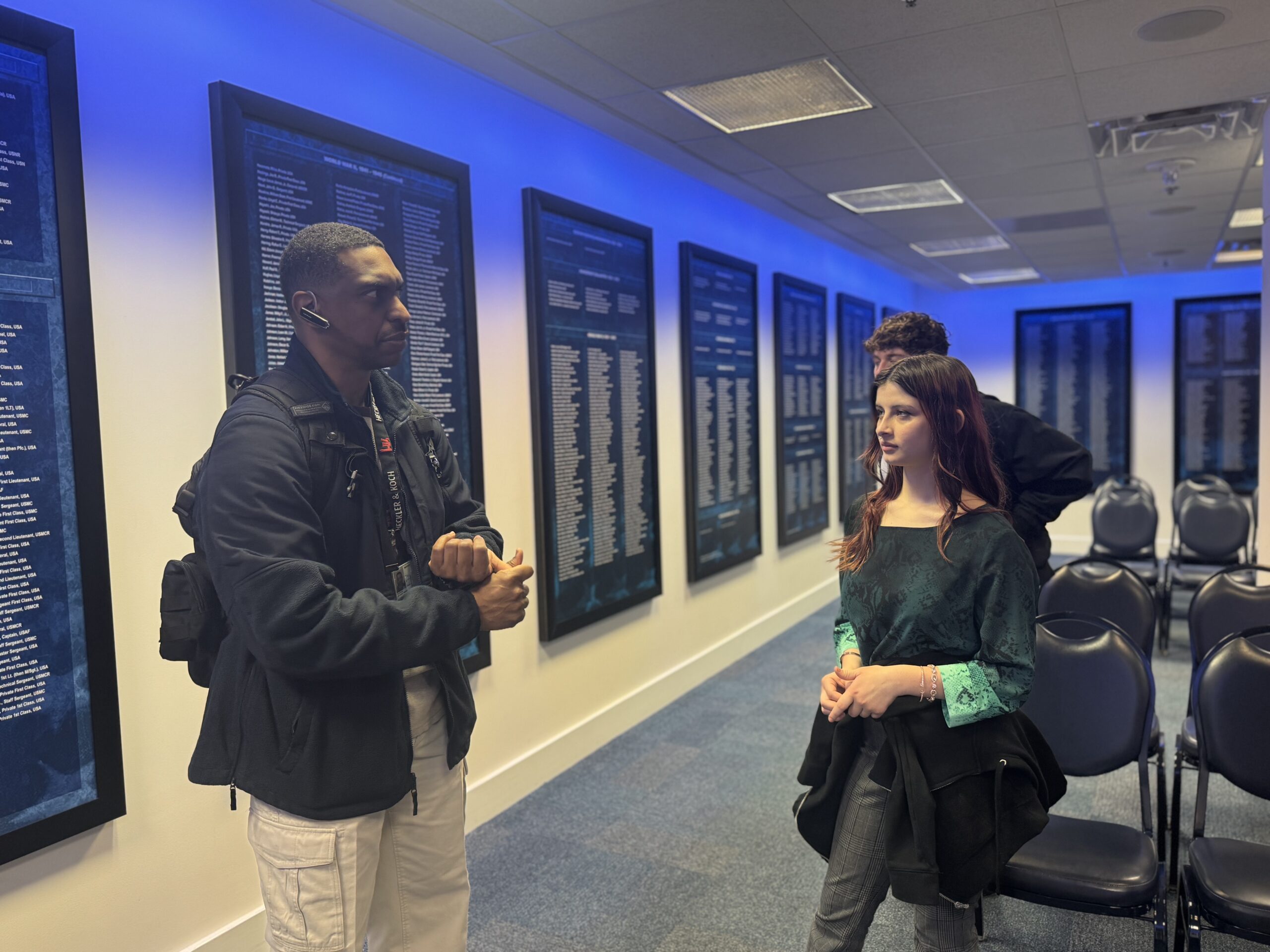
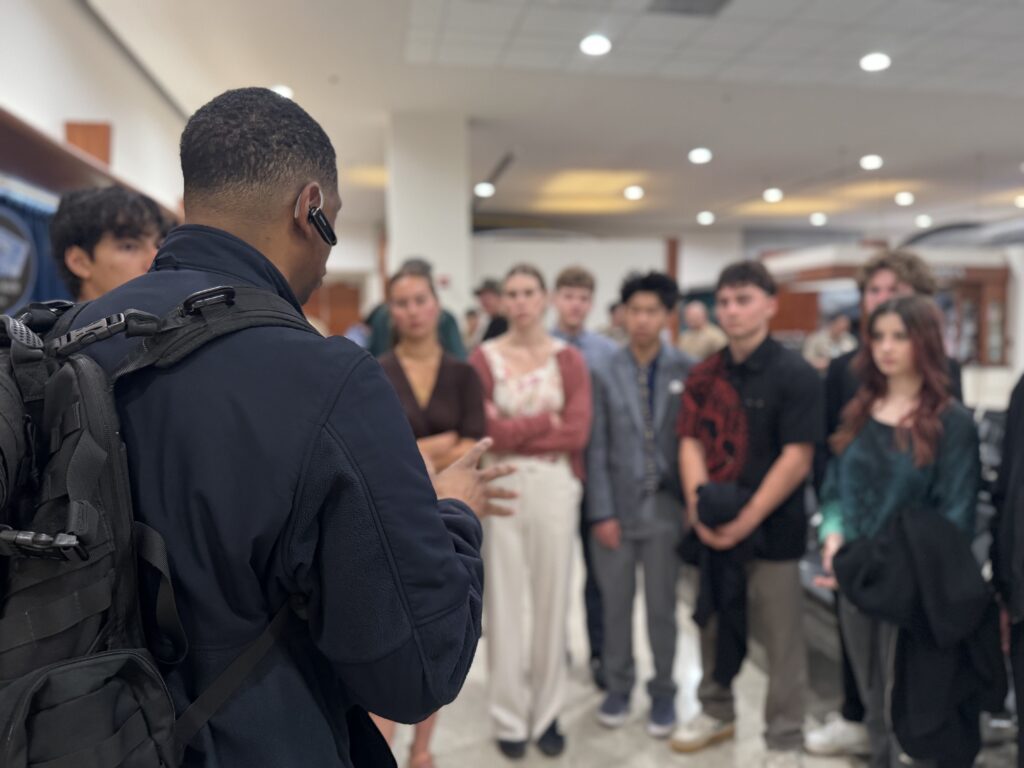
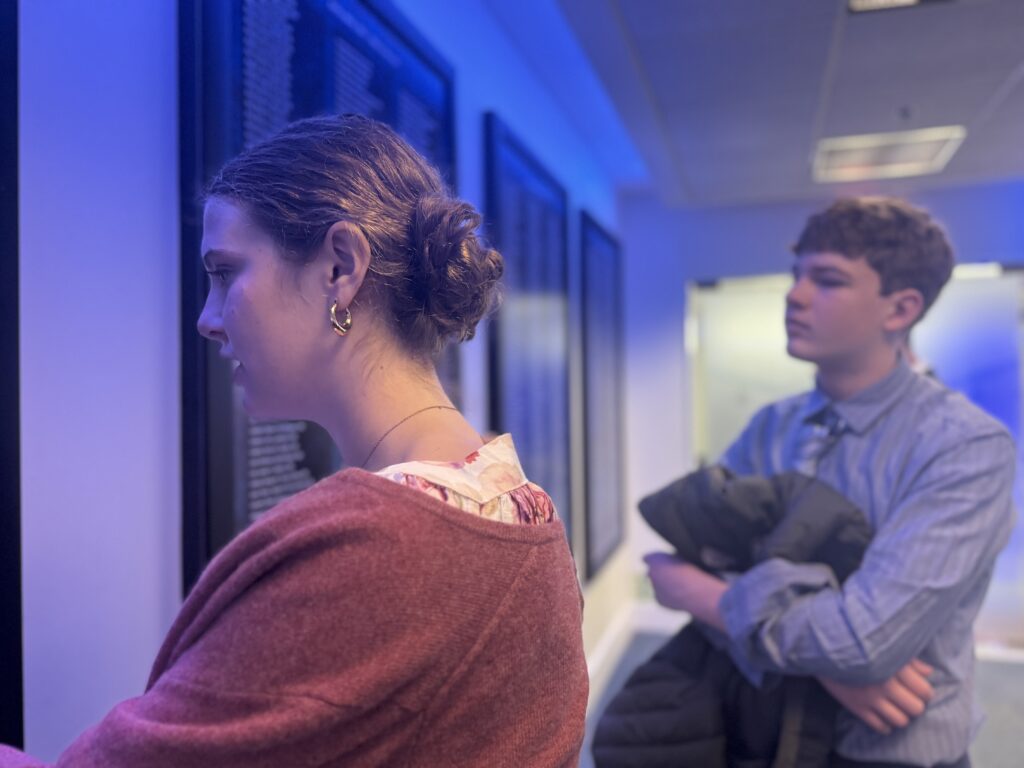
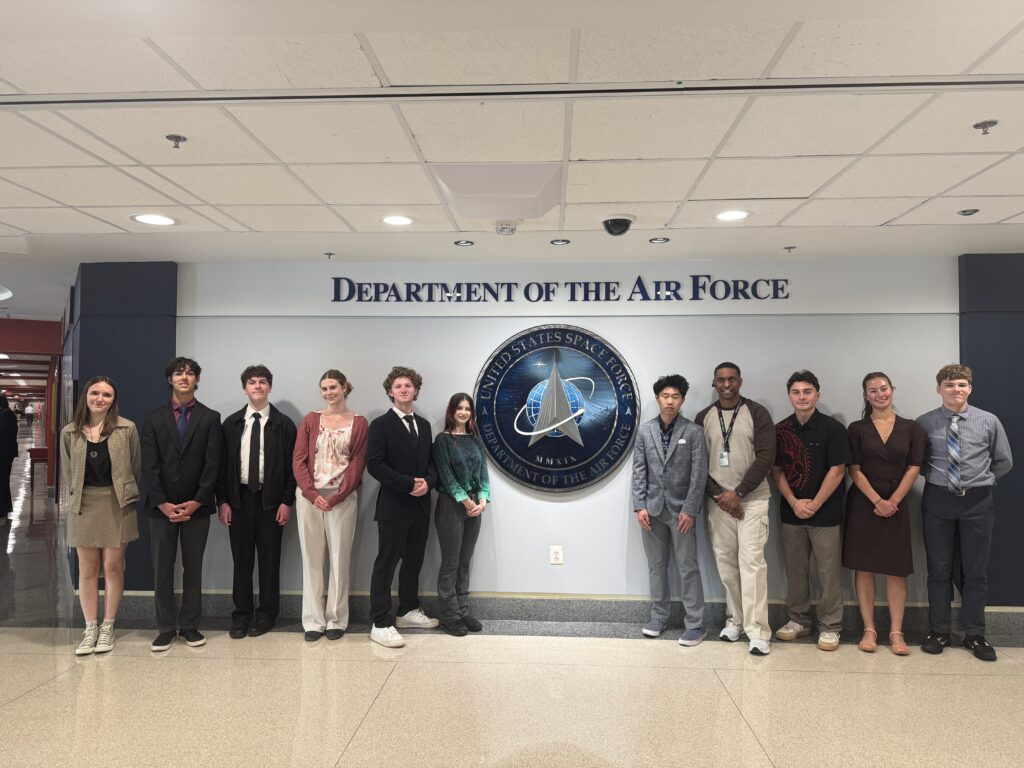
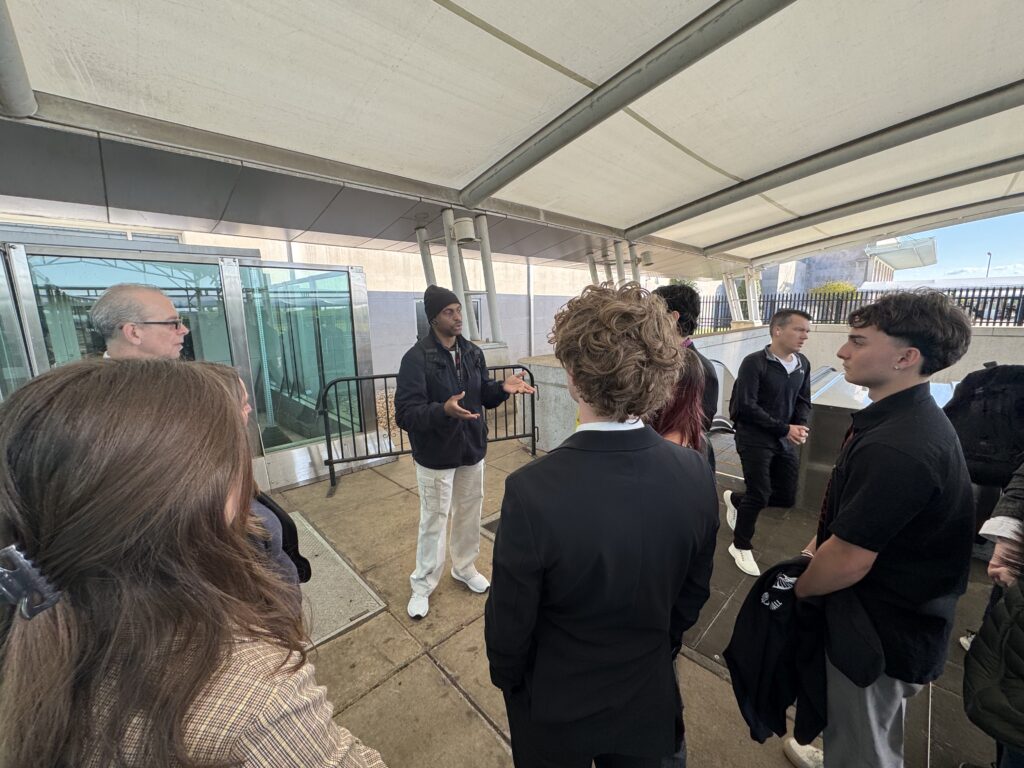
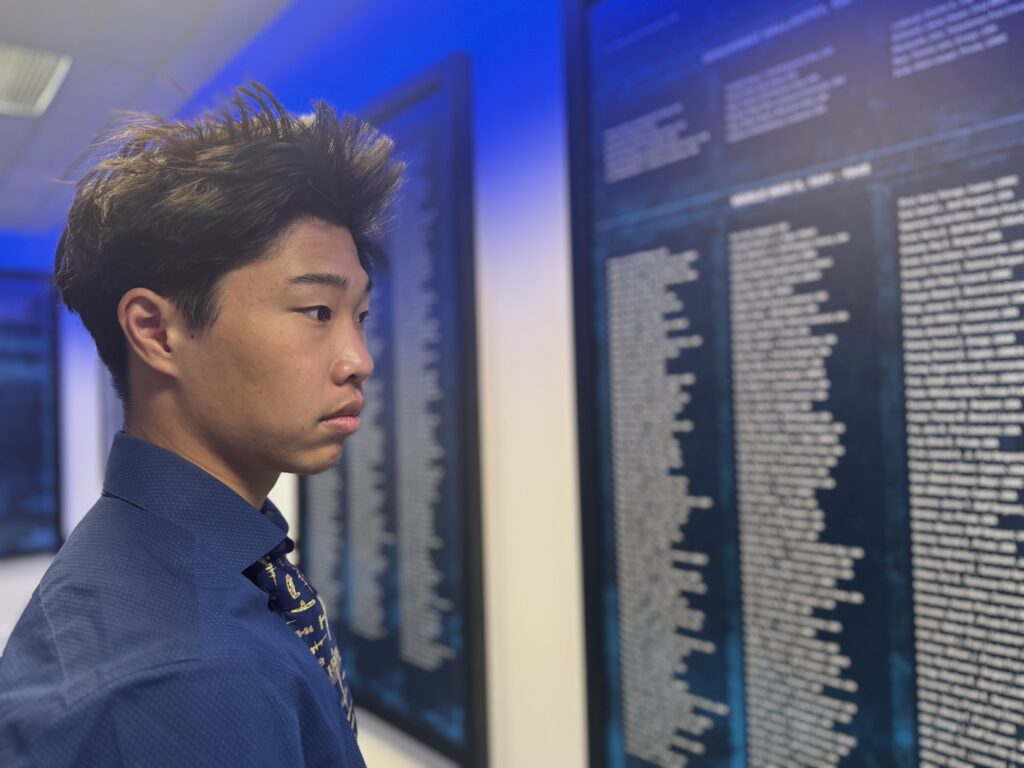
After the interview we ate delectable Lebanese cuisine and I had a mango lassi at the Pentagon food court. Then we posed for photos with Mr. Jackson and Mr. Corey and then we visited the 9/11 memorial, where Mr. Jackson told about his Army team’s experiences during that tragic event. We stood in silence at the site where one of the planes had struck the Pentagon.
Finally, Officer Jackson talked about the new Space Force, and we saw models and he shared fascinating facts about it. We wrapped up our visit with a stop at the Pentagon gift shop. We said goodbye and headed back home on the Metro, reminiscing about our amazing experience at the Pentagon.
-Hans Hagge
In Service of the Truth
I was incredibly nervous to visit the Pentagon. Throughout the week, and especially in the beginning, I was very intimidated by my interviewees. However, I’ve become more comfortable interviewing people. Similarly, the longer I spent at the Pentagon, the more comfortable I became.
The impromptu interviews there were some of the most transformative I’ve had during my time in DC. My favorite interview at the Pentagon was with an NBC Pentagon correspondent. I have long considered being a reporter, and talking to her confirmed my desire to become one, and now I want more than ever to pursue that career.
Throughout our DC trip, the topic of service to something higher than oneself has been discussed. I bring this up because the NBC correspondent recounted her time as an embedded reporter covering foreign wars, where she faced constant danger. Hearing her story gave me a new understanding of what it means to take risks in the service of the truth, of others, and of something bigger than yourself. It’s one thing to report the news from the safety of a studio; it’s another thing entirely to live in the uncertainty of war zones, guided only by the purpose of informing the world.
For me, the Pentagon doesn’t just symbolize power and bureaucracy; it is a space where people devote themselves to something that is far more important than personal gain, serving the greater good. The journalist who risks her life to tell a story and the police officer who dedicates his life to public service both share a sense of duty that makes me rethink what kind of life I want to live.
-Eli Moody
The Pentagon, Public Service, and Lebanese Food
I was already familiar with the Pentagon before we went there. I had read several books on it, including one about 9/11, and I had even been to the Pentagon once, although I was unable to go inside. I was therefore most excited to visit the Pentagon, and I was not disappointed.
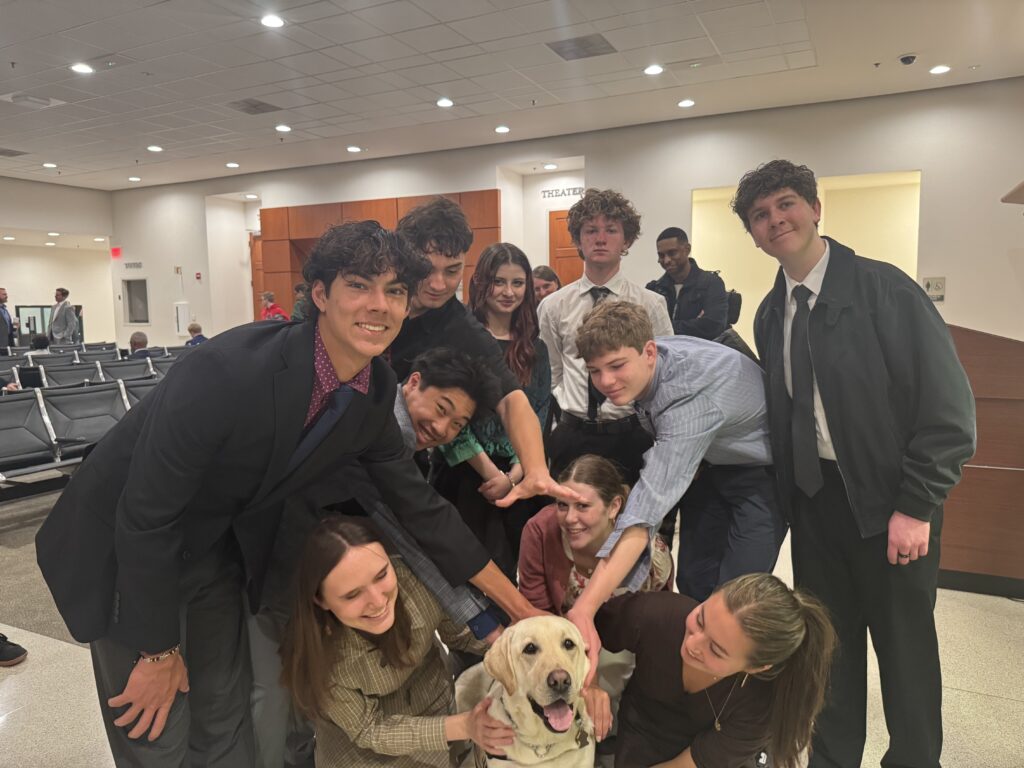
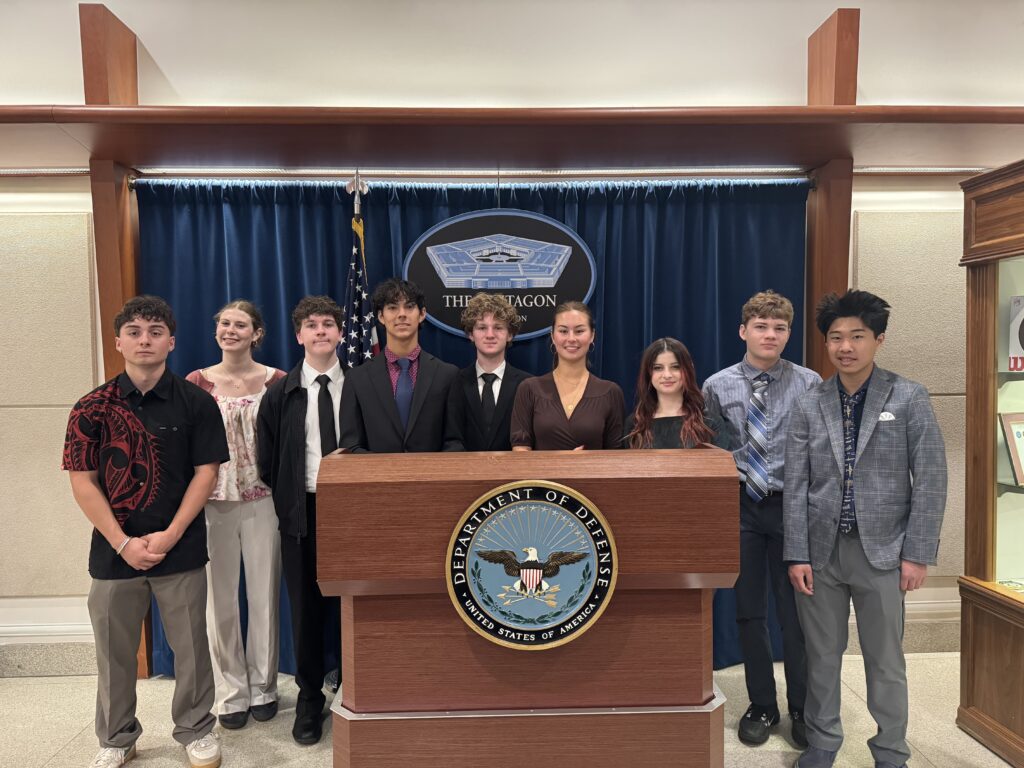
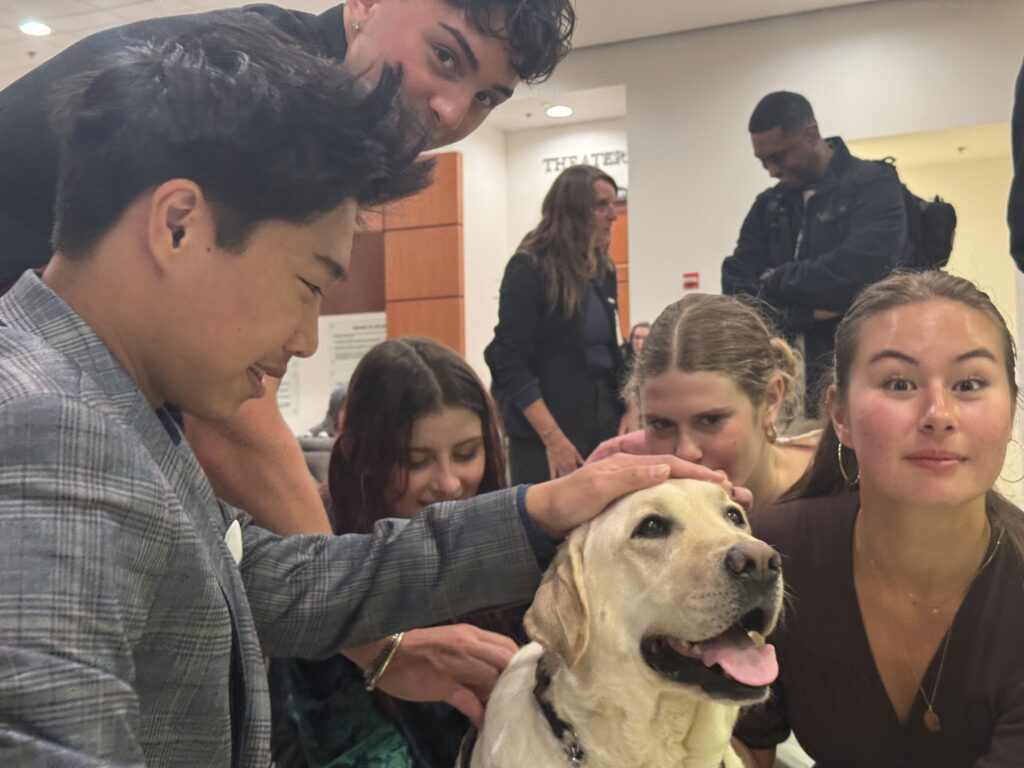
We took the Metro, and we arrived on time. We were met by our guide, Officer Anthony Jackson, who works for the Pentagon police force. He led us inside, where we took some pictures and met a therapy dog named Charlie. He had apparently not become an actual service dog because he was “too motivated by food.” After that, we went to Officer Jackson’s office, and we got to interview his boss. He was very nice, and along with Officer Jackson, he was very dedicated to his job and service to others. He was also very interested in talking to us.
After our impromptu interview with the police chief, we had another unexpected interview, this time with a correspondent from NBC. She has been to numerous countries, and has served as a war correspondent. She is a highly impressive woman, and I was struck by her sense of service to others. I was also impressed by her work commitment and the positive nature she radiated for her interview. Afterwards we got Lebanese food, which I was fortunately able to eat, as I am gluten free. What was even more surprising was that it was great, and I ended up saving some for leftovers.
Finally, we went to the 9/11 memorial, and I found out that Officer Jackson had been at the Pentagon as a soldier to help with the aftermath of the attack. He and his Army platoon were there for several weeks, helping to clean up. As we left, I was struck by one last thing, that my keen interest—almost an obsession—in military history felt validated.
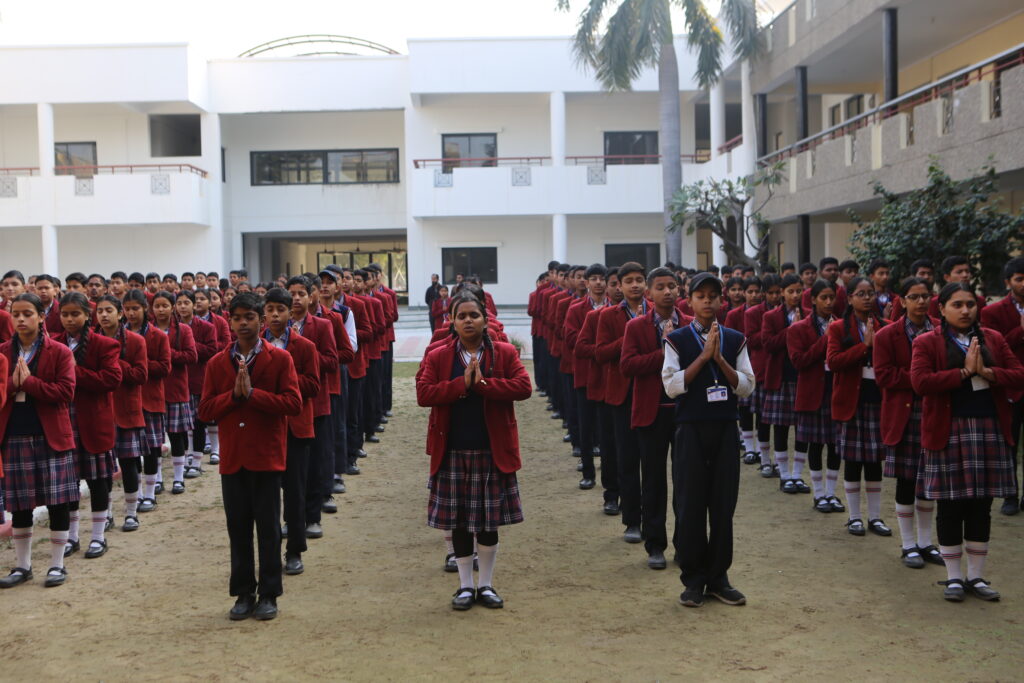
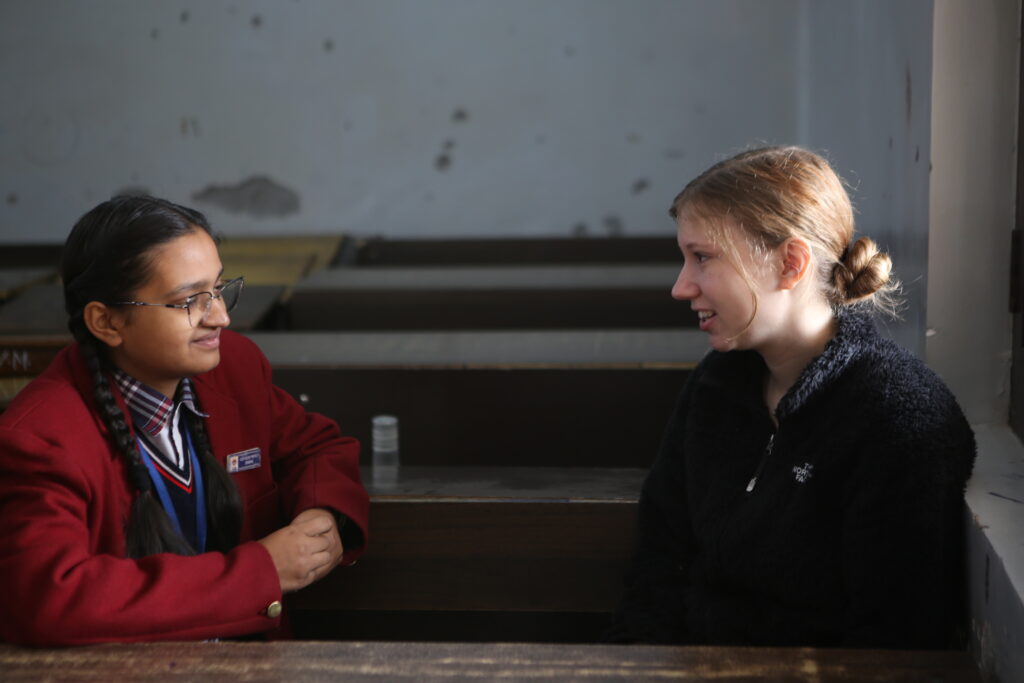
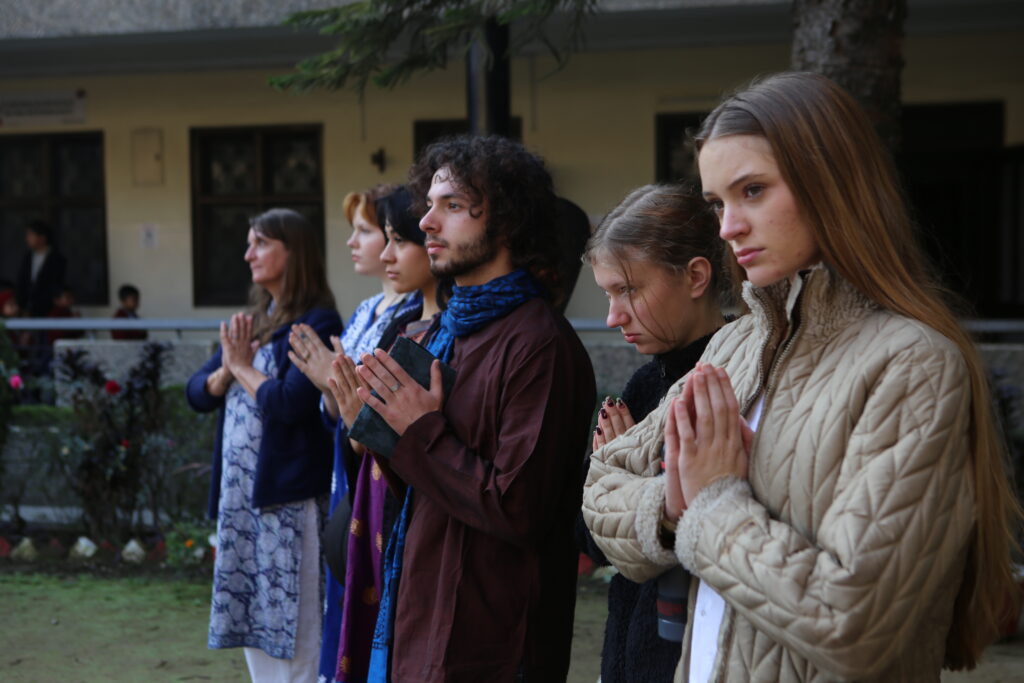
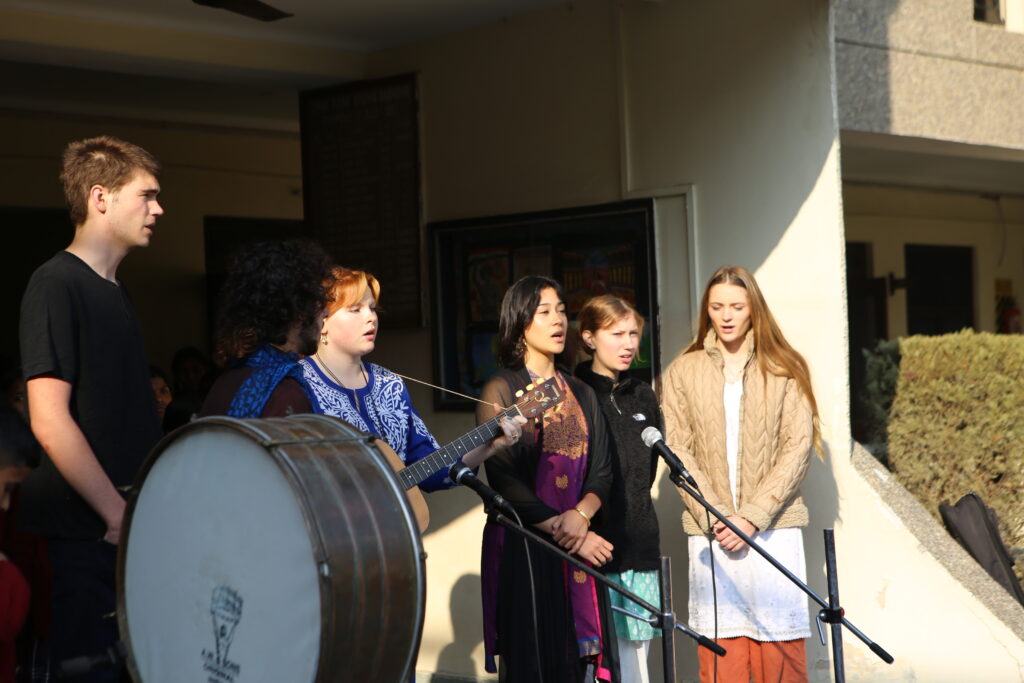
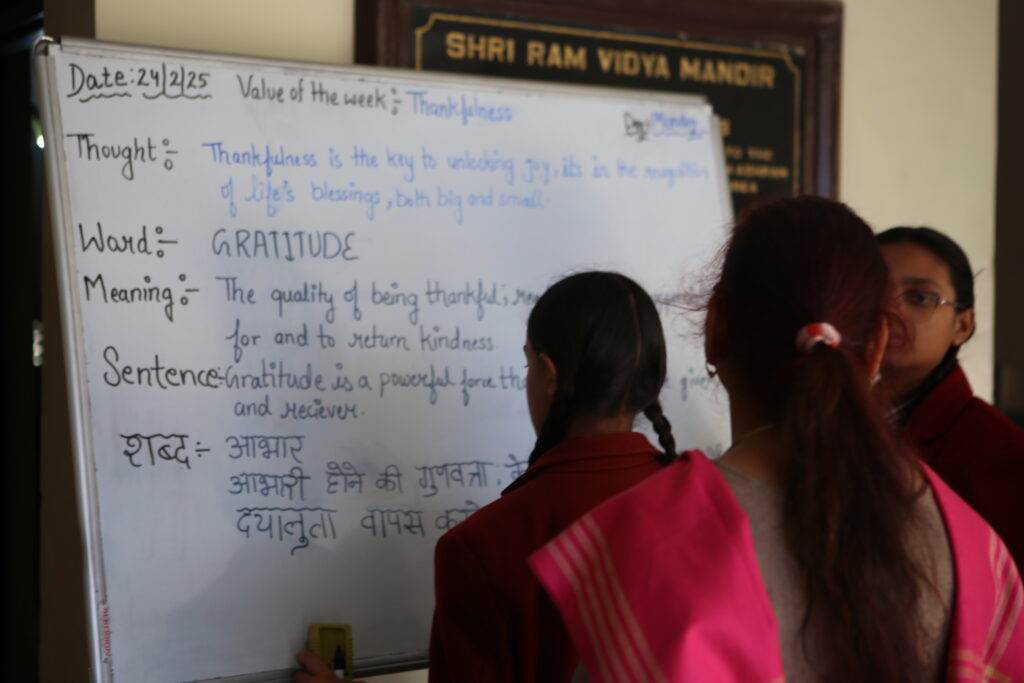
We visited the Sri Ram Vidya Mandir School which is our sister school in India. The school was founded by Baba Hari Das, the same person who inspired the founding of Mount Madonna School (MMS). The culture at SRVS felt similar but also different from MMS.
All of the kids that I talked to acted exactly the same as kids I’ve met from the U.S. and other countries. One girl told me about how she was sad that her best friend had recently changed schools. I understood how she must have felt because no matter your culture or religion a best friend is still just as important. I related with another girl that I talked with about our love for art. We agreed that it was one of our favorite subjects in school. We talked about how fascinating it was to draw from life and how crazy it felt to watch a blank page turn into a three dimensional object. We continued to talk about school and how it impacts our lives. She told me that her biggest motivator was her god. That believing in her god brought her passion and curiosity in school work. She asked me if I believed in a god. I told her that my mother was raised Catholic and that my father was raised Jewish but had chosen not to identify with a specific religion. I said that I had religious connection with my family history but couldn’t say that I affiliated with a specific god. When she asked the question I found it interesting that she asked if I believed in “a god” versus just beloved in god. This made me think about how different our culture is in the U.S. where most people believe in one god. Whereas in India, people may choose a specific god that they worship. The way she phrased the question also made me believe that it was more open-ended. She was just asking if I believed in a higher power and not expecting me to participate in her religion.
My schooling experience was also different from theirs in two other major ways. In India, after 10th grade, students are expected to pick a “stream” to follow; Science, Humanities, or Commerce. Once they have chosen, they take classes exclusively to apply to what they have chosen. This shocked me because of how much general education we have to take for our school system. It is crazy to me how different education systems are in different countries. Another thing that was different was the rigidity of their school. In the morning they stood in a straight line, separated by boys and girls of each grade, and followed orders given over the speaker. The school was much more strict than schools in the United States. However, once we went into the classrooms and saw the projects and kids all hanging out, it felt similar to Mount Madonna school.- Amelie Zands