
Reflections on Self and the World

Last night we had dinner at a beautiful home in Dehradun. Our hosts had invited a diverse group of leaders and spiritual pilgrims, and they asked us to introduce ourselves one at a time and tell the group about a moment when India had made an impression. Keep in mind that we had only been in the country for two days. I said something in the spur of the moment. The more I let it sit, the more I realized it increasingly resonated with me. This is the story I told.

Growing up in the same household, in the same city, with the same experiences for 18 years has led me to look at the world in a certain type of sheltered way. Of course, having access to the internet and other people’s stories has allowed me to gain a vague understanding of the extent of my privilege, but that only went so far. My privilege was something intangible, far away, and hazy.
Growing up, I thought that I had smelled all there was to smell, seen all there was to see, and developed the worldview I would carry for the rest of my life. That wasn’t the case at all. Of course, it was arrogant to think this way, especially because I knew I had only seen a fraction of the world.
The second I left the airport and stood in New Delhi, everything I had assumed shattered. We had talked about letting go of our assumptions in class previously, but I never expected it to be so drastic. Actually experiencing the contrast to my small, sheltered life was overwhelming. I thought I knew how cities were laid out, and then I encountered Delhi. This sprawling metropolis was bustling, and so energetic that I believe even a seasoned New Yorker would be overwhelmed by it. Immediately, without even trying, Hans and I began counting things that were foreign. We could not look out the window of the bus and find something that was not new to us. I admit this was our way of clinging to familiarity, and eventually I gave up counting, as I realized it would be more efficient to count something that was familiar instead. Additionally, after only two days in India, my worldview has profoundly altered. With ten more days on the ground in this country, I think that this is only the beginning of India’s impact on me. In order for a trip to be truly life-changing, it is not just your external beliefs that change, but the ones you hold dear at your core, the quiet assumptions you didn’t even realize you were carrying.Maybe I haven’t seen all there is to see after all. Maybe I’m only just beginning to notice how much I never understood in the first place.For now, I’m learning to stop counting what’s different and start paying attention instead.

CED Society
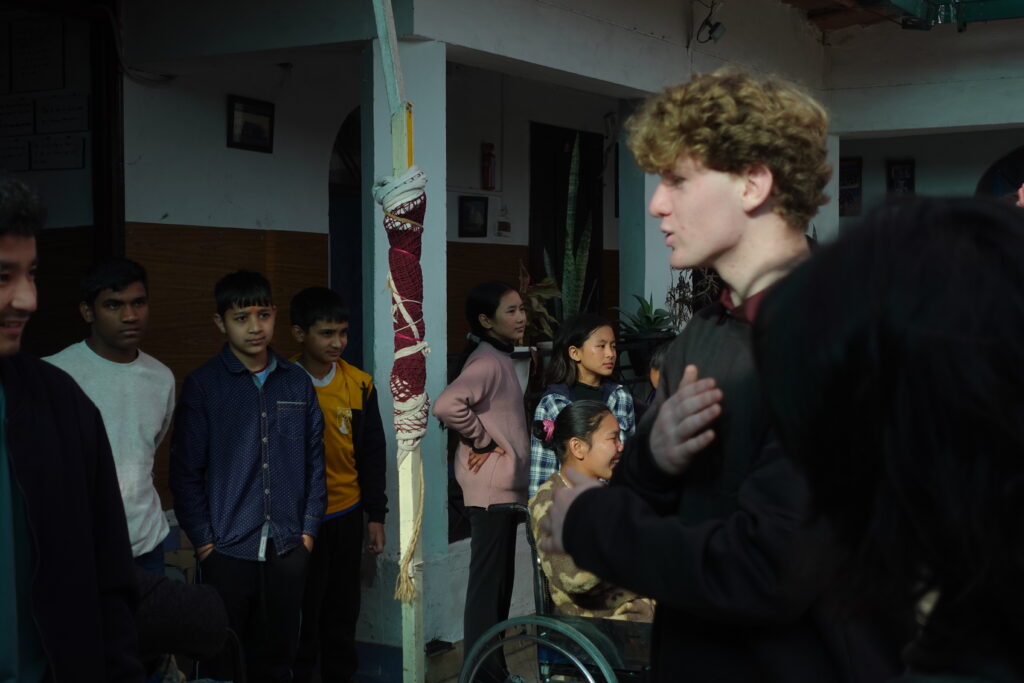
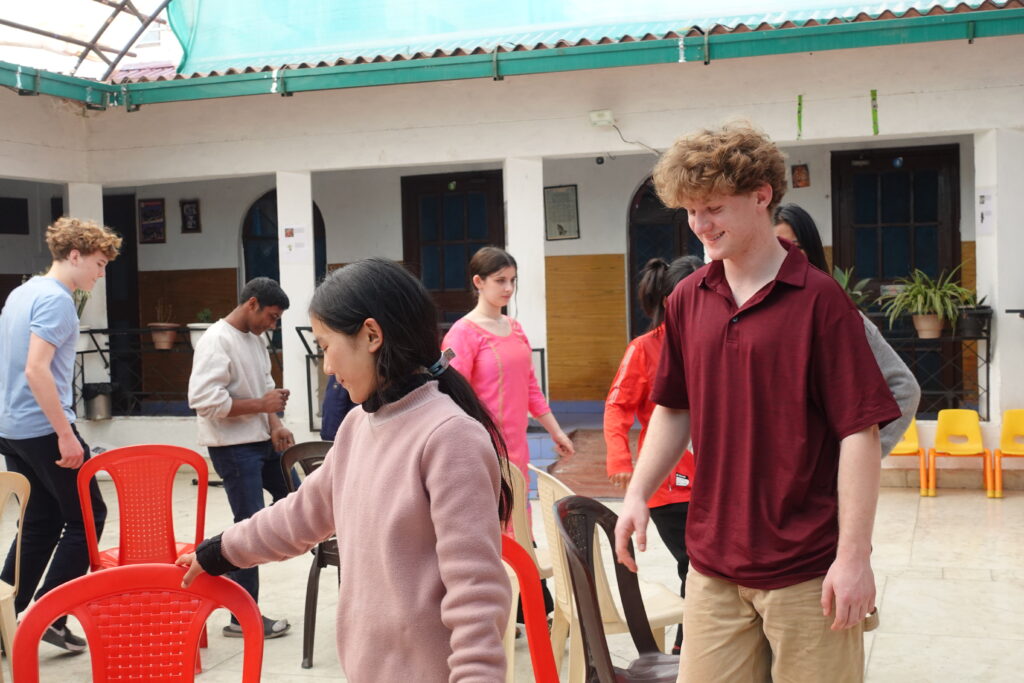
Today, our class visited the Children’s Education and Development Society (CED Society), which hosts a number of children from different parts of India as well as Tibet. Most of these children have a horrific origin story. Many forced to work very early in their lives. Some were ostracized in their home village because they had a disability, or they were excluded from education simply because they are female.

Each child has their own unique story, and when I stepped into the homespun comfort of the CED Society walls, I was excited to learn about each and every one.
I spent the most time with 2 girls named Pema and Hema, both of whom were disabled. Pema was instantly welcoming and kind, similar to her fuzzy brown pajamas with a bear print all over. I talked to her about her life at the CED society, as well as her hobbies. She told me that she enjoyed singing as well as piano. She sung a song for me which was beautiful, and then we sang a song together.


I felt very connected to Pema in this moment. I felt the joy of communicating through music. One thing that I noticed over and over at the CED society was how creative everyone was. Despite the circumstances in which these children had arrived in the world, they all still found a way to create music or art. One child named Khushi couldn’t speak or hear, yet she danced with great enthusiasm and accuracy. Other children loved to play the piano or the guitar. Lisa brought bright colorful Disney pens, and each child was excited to use them and showcase their drawings of things they love. Donuts, and dogs, were the most popular.
Going into the CED society, my first goal was to treat these children like my literal and immediate friends. I did not want to seem like I was just being friendly because I wanted to be a good person or because I was forced to bond. I genuinely wanted to connect and be friends with these children and form an actual friendship. I believe I did that, and I am grateful that we have a chance to return today and cement the bond.

A Gift for the Elders was a Gift to Us

After spending all day playing with children at CED society, we went with Lama Tenzin to distribute warm hats and socks to some old folks living in a local home for the elderly. Immediately upon arriving I was struck with the stillness and tranquility of the home. It was really quite a contrast to the rest of the day.
Everything about India is bright, loud, busy and overwhelming; this is even more true in the childrens’ home where we had just spent our day. A pocket of peace and reverence, however, was created for the inhabitants of the home for the elderly.

Methodically, Lama Tenzin gave us each clear instruction on how we should hand out the hats and socks. He was careful to show equal consideration for the quality of our experience as well as that of the elders. We created a procession line of sorts, as the elders walked down the table we each handed them an item while bowing our heads as a show of respect. It was a simple exchange and a simple experience, with the sole purpose of distributing the items. After distribution we waved goodbye, got scolded at by Shannon for making eye contact with one of the monkeys playing on the surrounding walls (it’s a sign of aggression), and left.
What I affected me most about this moment was the truth in the experience. The scene is: a bunch of privileged, western children, handing out clothes and money to elders at an old folks home, most of whom are Tibetan, under the guidance of one of the most self-less people on the planet, Lama Tenzin. I initially felt panicked that there might be offense taken at our gesture, any thoughts of pity or “this is just charity.” However there was none of that sentiment echoed by these elders, nor was there overwhelming emotional gratitude, just ceremonious acceptance.

As I reflect on my initial feelings and then the truth of what really happened, it’s quite clear why there was such a discrepancy between the two. These elders felt no shame about accepting our gifts, because no shame was required of them. Their life and wisdom earned them our kindness, care, and reverence. The truth I found is that in our western, individualistic society, we do not treat our elders with nearly the same level of respect that most other countries do. A respect that was palpable in this home. It was crystal clear to me. From the way they manage to create a peaceful haven, to the ceremony Lama Tenzin had us create just to hand out some clothes and money, there is a recognition of these elders and their experience. I saw clearly how important it is to make people feel valued, especially towards the end of their life. These elders, no matter what experiences they’d gone through in their life, or ailments they had, still shone with such joy. I don’t think that is something you see often in homes for the elderly in the west.
The whole experience was a beautiful reminder of what is possible for elders. If a country with as many people as India, who are all very different, can create a sacred and peaceful space full of reverence, imagine what is possible for us.
